


 © La clemenza di Tito, Gran Teatre del Liceu (2026) (c) A. Bofill
La clemenza di Tito is one of Mozart’s operas that has most often had to endure a certain degree of condescension from critics and music historians. It was an occasional work, written in haste for the coronation of Leopold II as King of Bohemia, based on an old libretto by Pietro Metastasio, dating from 1734 and already used by numerous composers. Caterino Mazzolà adapted it for the occasion, and Mozart had only a few weeks in which to set it to music. It hardly seemed the most promising starting point for a work destined to stand the test of time.
Moreover, La clemenza di Tito is contemporary with The Magic Flute, the Ave verum corpus and the Requiem. Comparison with these masterpieces has done it few favours. But perhaps we have been wrong in our assessment of this opera. For, beyond the conventions of opera seria, a genre already beginning to show signs of fatigue, Mozart wrote music of extraordinary quality. The arias for the various characters, the vocal writing and, above all, the orchestration of the highest order place the work far above the level of a mere concession to the circumstances of the commission.
There is also the dramatic question. The characters in La clemenza are caught between duty and desire, love and fidelity, friendship and betrayal. Mozart knows how to express these conflicts in music with admirable precision. Despite the somewhat cardboard plot, the music goes far beyond the conventions of the drama. This is where the work’s true stature is to be found.
La clemenza di Tito, Gran Teatre del Liceu (2026) (c) A. Bofill
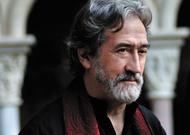
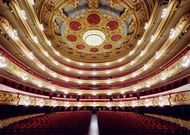
In the pit of the Gran Teatre del Liceu, Jordi Savall’s conducting was warmly received by the audience, who applauded him at length at the end of the performance. The impression of the present writer, however, was somewhat more reserved. Savall is a musician of exceptional distinction, but opera does not strike me as the field in which he is most at home. He is considerably more convincing when exploring the repertoire of the sixteenth and seventeenth centuries, and even that of the first half of the eighteenth, or when conducting sacred music. Mozartian Classicism, by contrast, does not seem to be his most natural territory.
His reading was excessively flat, with tempi that were too uniform and insufficiently nuanced. Everything was kept at a moderate pace, one that ended up serving musical and dramatic situations that were quite different from one another. What was missing was contrast, flexibility and, above all, expressive emphasis. The conducting was elegant, certainly, prudent and delicate, but lacking in incisiveness. Savall also barely looks at the singers, and at times gives the impression of remaining somewhat detached from what is happening on stage. But this is opera, and things happen in it. The music reflects them, and the performance should do so too.
Le Concert des Nations deserves a favourable assessment. It produced a fine sound, consistent with the period instruments and the ensemble’s interpretative principles. Some of the brass sonorities may seem harsher than those of a modern orchestra, but they are part of the ensemble’s character. Particular mention should be made of the clarinet accompaniment in “Parto, ma tu ben mio”, Sesto’s aria, and the basset horn in “Non più di fiori”, Vitellia’s aria: two moments of great instrumental beauty.
The Capella Nacional de Catalunya also gave a good performance, although the opera’s choral interventions are not especially demanding. The ensemble, prepared by Lluís Vilamajó, fulfilled its role satisfactorily. Savall is accustomed to surrounding himself with highly accomplished collaborators and ensembles, and both the orchestra and the chorus provide him with a solid foundation.
La clemenza di Tito, Gran Teatre del Liceu (2026) (c) A. Bofill
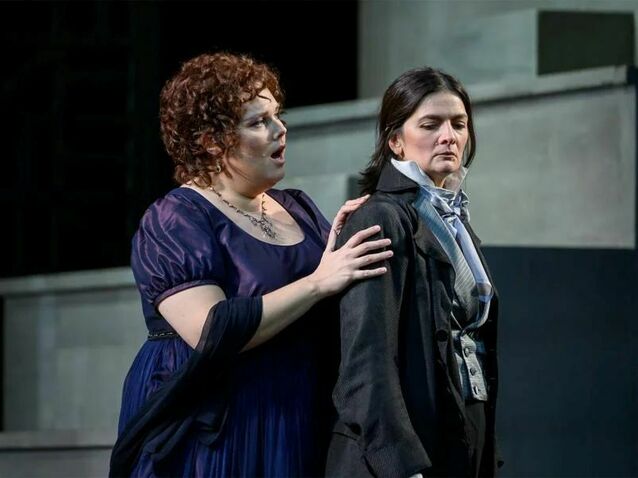
As for the cast, all the singers were making their Liceu debuts. The overall standard was competent, with no clearly inadequate performances or vocal disasters, but there was little to inspire enthusiasm either. The exception was Marianne Crebassa, who took the role of Sesto. The French mezzo-soprano was, by some distance, the finest singer of the evening. She has a beautiful, well-focused and extensive voice, a highly refined sense of phrasing and, above all, a thoroughly assimilated Mozartian style. She met the demands of an especially challenging role with natural ease, both vocally and dramatically.
Jack Swanson, as Tito — whom we shall soon see again in another Mozart role, that of Tamino — fell short of what might have been expected. The American tenor enjoys a certain reputation in the Mozart and Rossini repertoire, and he negotiated the passages of agility without ever quite making them shine. He lacked the expressiveness, warmth and interpretative vigour needed to give the character the full dimension the role requires.
Gabriel Rollinson offered a Publio with a good vocal line and appreciable expressiveness, but his voice lacked the projection required in a theatre the size of the Liceu. A similar difficulty, though less pronounced, was evident in Marianne Beate Kielland, who sang Annio with elegance and correctness, but whose voice was somewhat limited in carrying power. Lina Johnson gave a satisfactory account of Servilia, with easy, relaxed singing and no complications.
Aurora Marthens, who replaced Karine Deshayes as Vitellia, was also less than outstanding. The recitatives were particularly weak, and the voice, with an unappealing timbre, lacked consistency across the range. Her top notes were well focused, but she has yet to acquire the Mozartian style the role demands. The great aria “Non più di fiori” passed without the distinction it deserved.
La clemenza di Tito, Gran Teatre del Liceu (2026) (c) A. Bofill
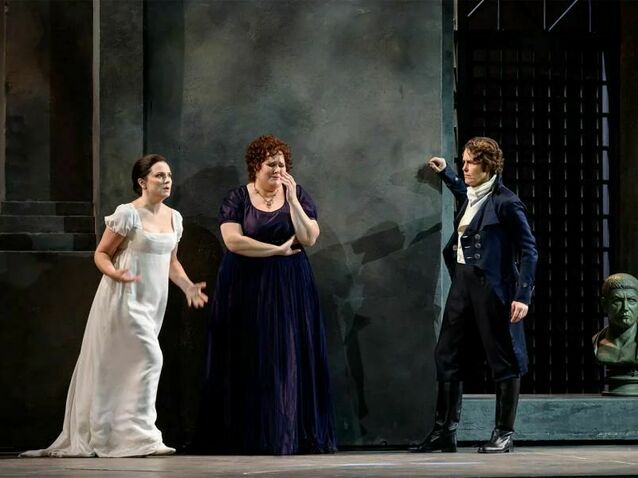
David McVicar’s production has a particular history at the Liceu. Created for the Aix-en-Provence Festival in 2011 and subsequently incorporated into the Barcelona theatre’s repertoire, it was first staged here in 2020, but the pandemic forced some of the performances to be cancelled before the run could be completed. For some subscribers, therefore, this revival has been a second chance, while for others, it has been practically a premiere.
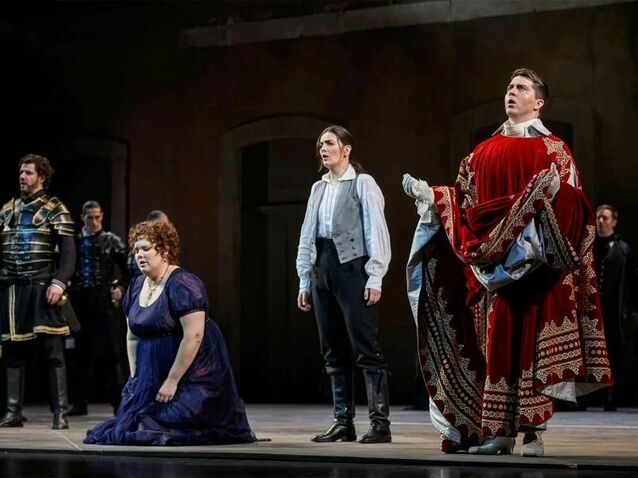
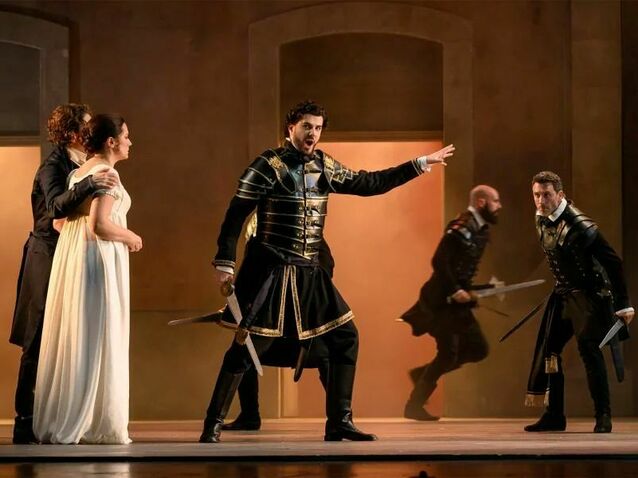
McVicar sets the action in early nineteenth-century Europe, with a Napoleonic atmosphere, rather than in imperial Rome in AD 79. The sets, with their monumental architecture, more neoclassical than classical, and Jenny Tiramani’s costumes, both male and female, evoke that period. Only the guards of Tito and Publio retain an unmistakably Roman appearance. This temporal duality is not particularly problematic and, in fact, helps give the production its distinctive character.
There is also a stage device that struck me as particularly successful. A kind of Praetorian Guard constantly surrounds Tito. Armed with swords and daggers, the guards spend much of the performance practising and demonstrating martial arts. Some members of the audience found this device ridiculous, but it has a very precise theatrical purpose: it breaks up the static quality of many scenes while also making visible the fragility of a power that needs constant protection. Tito is emperor, but he lives under the threat of conspiracy and betrayal. His authority is not as secure as it might appear.
The Napoleonic reference becomes particularly explicit at the end, when Tito appears wearing an extraordinarily long red cloak that trails across the stage. The image inevitably recalls Jacques-Louis David’s celebrated painting of Napoleon’s coronation. Tito’s identification with the French emperor provides the key to understanding the production’s overall setting. Napoleon is, quite simply, the paradigm of the emperor in the Western imagination of the nineteenth century, a figure who allows today’s audience to engage with the question of absolute power and its contradictions.
The lighting was competent and professional, without any particularly significant expressive value beyond the red tones that heralded the fire at the Capitol. The principals’ stage movement was not especially varied either, but the contrast with the guards’ constant activity provided a degree of dynamism. All in all, this is a visually attractive, well-constructed production which, despite its fifteen years on the stage, has not aged badly. The audience received it without any particular enthusiasm, but did not challenge it either.
Finally, there is a certain naivety in Tito’s moral outlook that may seem almost surprising today. His pronouncements on government and clemency sound like genuine lessons in good governance. When he says that, if the empire requires a harsh heart, it would be better to take the empire away from him or change his heart; when he declares that he wants to win his subjects’ loyalty through love rather than fear; or when he thanks Servilia for her honesty in confessing that she loves another man, Mozart presents us with a ruler of almost absolute moral rectitude. This conception of power has an Enlightenment dimension, as well as a clearly recognisable Masonic undertone.
Yet it is impossible to resist a mischievous smile at Tito’s magnanimity. For the final pardon of Sesto and Vitellia has a particularly curious consequence. Sesto, the beloved friend who has betrayed him and taken part in the conspiracy to murder him, not only keeps his life but is also granted permission to marry Vitellia, the instigator of the entire plot, a formidable, domineering, amoral and manipulative harpy. Clemency, certainly. But, when one considers the married life that awaits poor Sesto, perhaps it is also a subtle form of revenge.
Xavier Pujol
Barcelona, 25 November 2026
La clemenza di Tito, by Mozart. Jack Swanson, tenor (Tito). Aurora Marthens, soprano (Vitellia). Marianne Crebassa, mezzo-soprano (Sesto). Marianne Beate Kielland, mezzo-soprano (Annio). Lina Johnson, soprano (Servilia). Gabriel Rollinson, bass (Publio). David Greeves (Lentulo). Le Concert des Nations. Capella Nacional de Catalunya. Musical direction, Jordi Savall. Chorus preparation, Lluís Vilamajó. Stage direction, David McVicar. Revival director, Leo Castaldi. Set design, David McVicar and Bettina Neuhaus. Costumes, Jenny Tiramani. Lighting, Jennifer Tipton. Fight director, David Greeves. A Gran Teatre del Liceu production (created for the Festival d’Aix-en-Provence in 2011).
the 28 of November, 2026 | Print





Comments