


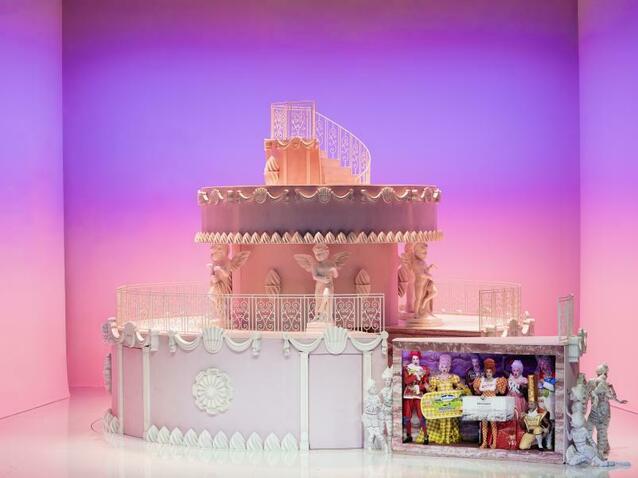
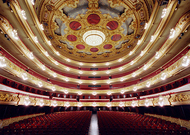
 © Gran Teatre del Liceu / David Ruano
Even before the curtain rises, the overture to Le Nozze di Figaro begins, and at once the audience starts to experience a surge of happiness. There are very few pieces of music that so clearly and reliably promise to usher the spirit into a state of happiness; perhaps only the opening Allegro of Mendelssohn’s Italian Symphony could be compared with it. Mendelssohn, like Mozart, was one of those composers who came into the world to make it a little more habitable and bearable.
It had been four years since the Liceu last staged this opera which, for the sake of one’s spiritual wellbeing, everyone ought to see at least once a year.
On the podium was Giovanni Antonini, whose conducting was light in tempi, meticulous in articulation and attentive to detail. On opening night there was more than one issue of coordination between voices and orchestra, but he excelled in accompanying the quieter, more reflective arias, thanks in particular to the superb response of the woodwind section, whose playing reached the audience sweetly and lovingly, enveloping it in sound.
The role of Count Almaviva was sung by the Tyrolean baritone André Schuen, already well known and highly regarded in Barcelona for his performances as an outstanding interpreter of Lieder, though this was his first appearance at the Liceu. Schuen is a fine artist and endowed the Count with the explosive combination of aristocratic detachment when dealing with the other characters and coarse lasciviousness when pursuing Susanna. The voice is beautiful and the style impeccable. The Liceu auditorium, however, is very large and consumes a great deal of sound, and Schuen’s Count lacked a little vocal weight. With slightly greater projection, this baritone could become an ideal exponent of the role.
Konstantin Krimmel, another young singer on a rapidly rising trajectory, had originally been scheduled to sing Figaro. A foot injury prevented his participation, and Luca Pisaroni, almost a specialist in the role, stepped in as his replacement. Pisaroni delivered a highly satisfying and thoroughly accomplished Figaro, bringing precisely the right measure of malice – transformed by Mozart into irony – to his dealings with the Count.
Le nozze di Figaro - Gran Teatre del Liceu 2026 (c) David Ruano
The principal female roles were equally well served. Sara Blanch was making her debut as Susanna, though one would never have guessed it, so completely had she mastered a character who is by turns ironic, furious, honeyed and seductive, and who is among the most multifaceted in the opera. Blanch captured all these nuances, and captured them well. Added to this was the pleasure of watching the grace with which she moved about the stage, a legacy of her early artistic training in classical and Spanish dance.
Adriana González was the Countess Almaviva. The voice is a fine one and the performance more than competent. The problem with the Countess is that Mozartians are inevitably in love with her. We carry an idealised image of the character in our minds and always hope for an even subtler diminuendo at the end of a phrase, an even sweeter legato, an even more seductively elegant line. González came admirably close to a character who may, in truth, be impossible.
Julia Lezhneva was the most warmly applauded singer of the evening. She embroidered every detail of Cherubino’s character and shone with a bright, effortless, agile voice in the role’s two celebrated arias and in the explosive trio with Susanna and the Countess, which she imbued with unsettling sensuality.
Roberto Scandiuzzi and Mireia Pintó appeared as Don Bartolo and Marcellina respectively. Pintó acquitted herself very well in a rather thankless role, while Scandiuzzi also coped effectively with his, arguably even more thankless, although the exhausting canto sillabato passagework of “La vendetta” proved somewhat burdensome.
Roger Padullés and Moisés Marín were both thoroughly reliable as Basilio and Don Curzio.
Special mention should be made of the character of Barbarina. Mozart was so generously gifted towards his creations that he enriched this entirely secondary, almost anecdotal character with a precious gift: the little aria “L’ho perduta”, a miniature jewel, exquisite and perfect in its simplicity. Lucía García did not squander Mozart’s gift and was utterly charming as Barbarina.
Le nozze di Figaro - Gran Teatre del Liceu 2026 (c) David Ruano
Le Nozze di Figaro was presented in a new co-production by the Liceu and the Auditorio de Tenerife, directed by Marta Pazos, with sets by Max Glaenzel, costumes by Agustín Petronio and lighting by Nuno Meira.
The central idea is more or less as follows: Le Nozze di Figaro, as its title indicates, features a wedding; weddings generally involve cake; therefore, let us set the opera inside a wedding cake.
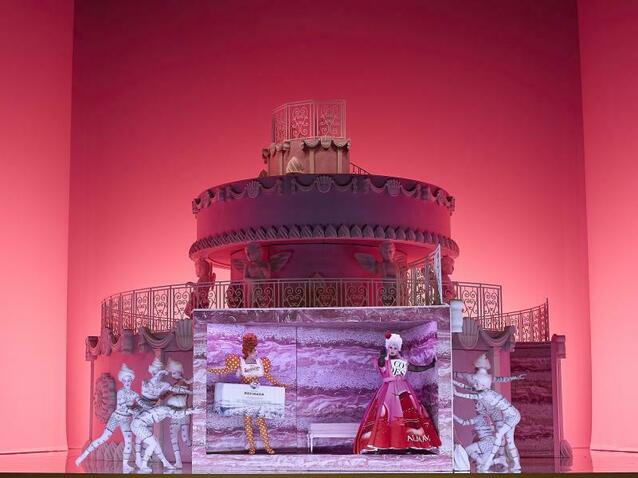
The concept does not exactly seem Nobel Prize material, but once realised on stage – which is entirely occupied by a monumental three-tier wedding cake through which the characters wander – it works, surprisingly well. The production functions effectively in theatrical terms, thanks above all to the excellent, meaningful and constantly changing lighting design.
Dramatically it is conventional, with relationships between the characters following the score and established convention. Theatrically it is extravagant but entertaining; playful yet superficial; cheerful and carefree but also rather childish – and there is nothing childish about Le Nozze di Figaro.
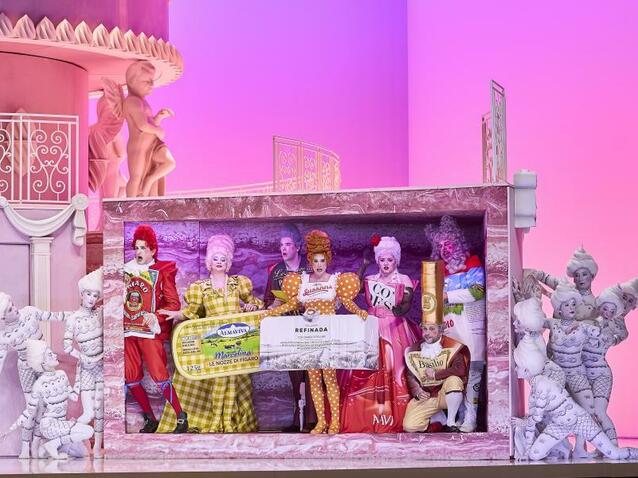
The costumes deserve particular mention. Until midway through the third act, everyone is dressed as a bakery-related product: one character appears as butter, another as sugar, another as skimmed milk. For the performers, it is highly restrictive attire.
The visual impact of these costumes is extraordinarily powerful, but disproportionate to the service of a dramatic idea as thin as cigarette paper. By the end they are all dressed directly as cakes, and at that point everything begins to look rather prettier.
For veteran Mozartians, it was difficult to listen to “Dove sono” – the most beautiful lament ever written for a past in which we once felt loved – sung by a Countess dressed as a Ferrero Rocher.
The production was further “enriched” by the addition of ten dancers who wandered continuously across the stage. For most of the evening they were a distraction, interfering with the enjoyment of arias that demanded intense concentration from both performers and audience. In some instances, however – for example during “Deh vieni, non tardar”, Susanna’s exquisitely tender invitation to love – the choreography enhanced the beauty of the piece still further. The Liceu Chorus clearly had enormous fun singing while dressed as cake cherries.
For the most part, the audience entered wholeheartedly into Pazos’s game and warmly applauded a production which – it must be said – was executed with impeccable theatrical craftsmanship and has every appearance of being a monumental and innocent joke.
That is the thing about the classics: they survive almost anything. This time, too.
Xavier Pujol
Barcelona, 5 June 2026
Le Nozze di Figaro by Mozart. André Schuen, baritone. Adriana González, soprano. Sara Blanch, soprano. Luca Pisaroni, bass-baritone. Julia Lezhneva, soprano. Mireia Pintó, mezzo-soprano. Roberto Scandiuzzi, bass. Roger Padullés, tenor. Moisés Marín, tenor. Lucía García, soprano. Luis López Navarro, baritone. Orchestra and Chorus of the Gran Teatre del Liceu. Giovanni Antonini, musical director. Marta Pazos, stage director. Max Glaenzel, set design. Agustín Petronio, costumes. Nuno Meira, lighting. Andreas Heise, choreography. Co-production of the Gran Teatre del Liceu and the Auditorio de Tenerife. Gran Teatre del Liceu.
the 09 of June, 2026 | Print


Comments