


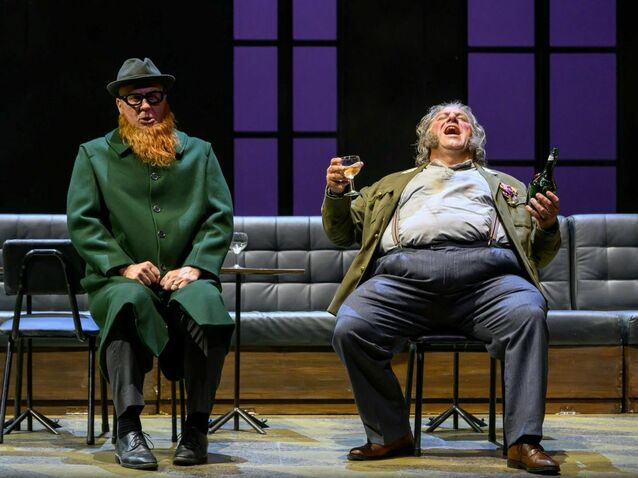
 © Falstaff, Gran Teatre del Liceu 2026 (c) A. Bofill
Few works are at once as light-hearted and as profound as Falstaff. Giuseppe Verdi chose to end his operatic career with a comedy when everyone was expecting another tragedy. Yet beneath the laughter lies a lucid reflection on old age, the passing of time, appearances and the human condition. The laughter in Falstaff is never superficial. Shakespeare, who created the character, had already mastered the art of blending the sublime with the grotesque, humour with melancholy, and Arrigo Boito, in his extraordinary libretto based on Shakespeare, preserved this delicate balance, which Verdi transformed into the most modern score of his entire output.
The production of Falstaff at the Gran Teatre del Liceu also carried an added symbolic significance. It marked the farewell of Josep Pons after twelve years as the theatre's Music Director and, at the same time, it brought the current Liceu season to a close. Three farewells, therefore, brought together on a single evening.
Laurent Pelly's production is probably the greatest asset of this new Falstaff. The French director once again demonstrates that he is one of today's finest specialists in comic opera. He succeeds because he never mistakes comedy for the mere accumulation of gags. Pelly understands that beneath Shakespeare's wit lies a profound compassion for his characters, and he avoids turning Falstaff into a mere grotesque clown.
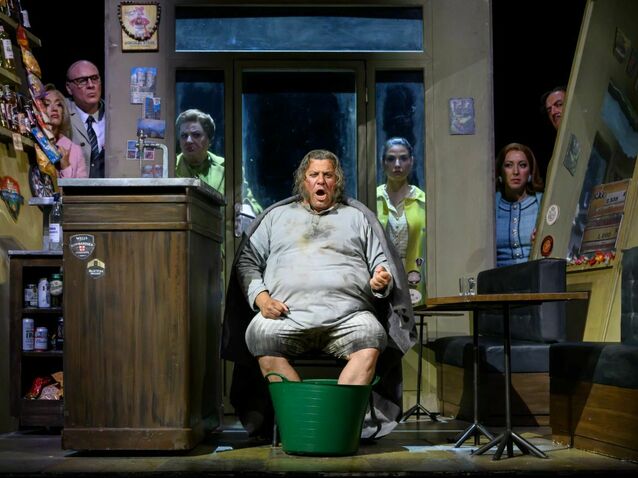
Falstaff, Gran Teatre del Liceu 2026 (c) A. Bofill
Here, the ageing, portly knight is certainly gluttonous, boastful, drunken and deceitful, yet he is also the whipping boy of a seemingly respectable bourgeois society that refuses to tolerate anything lying outside its conventions. Falstaff is excessive, but he also embodies a form of resistance and quiet subversion in the face of a world ruled by appearances, petty ambitions and everyday hypocrisy. He seeks to defy the passing of time by retreating into the self-deception of fantasy.
Pelly observes all his characters, but Falstaff above all, with a compassionate gaze. His direction is built upon detail, gesture and the relationships between the characters rather than on spectacular theatrical effects. The action is transferred to the mid-twentieth century without ever betraying Shakespeare, Boito or Verdi. Everything unfolds with admirable naturalness.
Barbara de Limburg's sets contribute decisively to this interpretation. The mobile structures allow the spaces to be constantly transformed, from the initial narrow, seedy tavern to the Ford household, full of staircases, permanently bustling and in motion. This continual movement avoids any sense of static theatricality and perfectly matches the headlong pace of both the music and the drama. Only the third act falls below the general standard. The nocturnal Windsor Park, which seeks abstraction in contrast with the realism of the preceding acts, proves insufficiently evocative and never quite creates the mysterious space where reality and fantasy ought to merge.
The final image, however, is magnificent. During the concluding fugue on the celebrated "Tutto nel mondo è burla", a huge mirror reflects the audience. The message is as simple as it is effective: we are all part of this great masquerade. The theatre is the world, and the world is theatre. In the end, perhaps the only true wisdom lies in learning to laugh at ourselves as well.
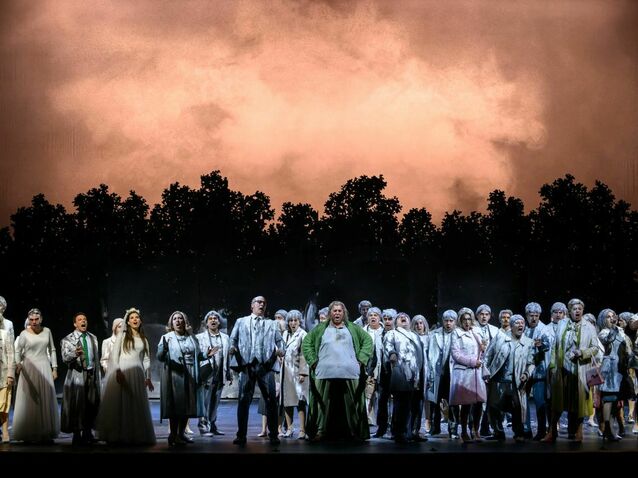
Falstaff, Gran Teatre del Liceu 2026 (c) A. Bofill
Musically, Falstaff remains Verdi's most astonishing opera. There is no overture, nor any great arias to interrupt the dramatic flow. Everything moves forward without pause in a continuous musical discourse in which ensembles clearly take precedence over individual numbers. It is Verdi's most choralopera and also his most forward-looking. With extraordinary courage and vitality, the composer deliberately abandoned the formulas that had made him a legend, choosing instead to write music that already points towards many of the sound worlds of the twentieth century. The orchestra acquires an entirely new timbral profile, and every inflection of the text immediately finds its musical counterpart, wrappingaround itlike a second skin.
Josep Pons took his leave with a performance that was both robust and intelligent. Over the past twelve years he has repeatedly demonstrated his remarkable ability to master some of the most complex scores in the repertoire, although Verdi has probably never been his most natural composer. His reading was consistently rigorous, carefully structured and full of finely observed orchestral detail, although one might have welcomed a little more lightness and flexibility, and rather less orchestral density in certain passages. In any case, it was a fitting farewell that confirmed the artistic level achieved by the Liceu Symphony Orchestra during his tenure. His successor will inherit an orchestra considerably more mature than the one Pons found when he first took up the post twelve years ago.
Luca Salsi is undoubtedly one of today's leading Falstaffs. He knows the character inside out, dominates the stage and sings the role with unquestionable authority. Even so, he still lacks that final touch of genius which transforms a great performer into a truly definitive Falstaff, as Gobbi, Bruson or, more recently, Terfel once were. His voice possesses weight and solidity, but at times it misses that extra measure of mischief—that irresistible blend of cynicism, irony and charisma that ultimately makes the audience feel the role was written especially for that particular singer.
As befits an opera conceived above all as an ensemble work, the cast proved stronger collectively than through many of its individual performances. Lucas Meachem portrayed a convincing Ford, although he often sang with excessive force. Santiago Ballerini acquitted himself honourably as Fenton, but without particular distinction and with limited projection, while Josep Fadó was an excellent Dr Caius. Pablo García-López perhaps overplayed the caricatural aspects of Bardolfo, whereas Alessio Cacciamani offered a vocally robust and well-projected Pistola.
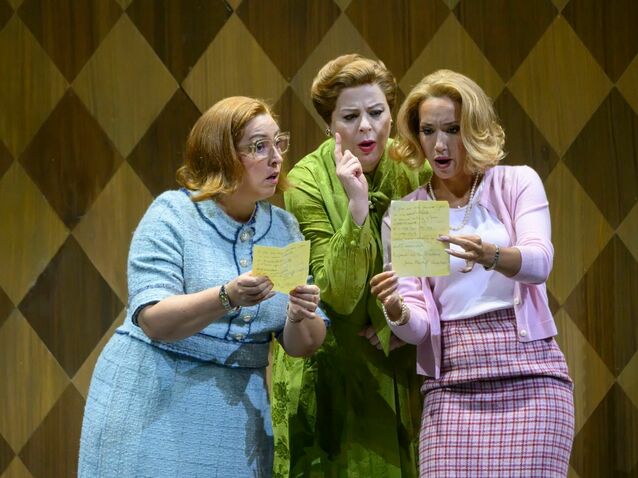
Falstaff, Gran Teatre del Liceu 2026 (c) A. Bofill
Among the female singers, Serena Sáenz was probably the most outstanding, although she did not fully seize the extraordinary gift Verdi reserves for Nannetta when, disguised as the Fairy Queen, she sings "Sul fil d'un soffio etesio". It is a moment that demands a voice of almost unreal purity, translucent, suspended in the air as though it truly belonged to a fairy. The magic was written into the score, but on this occasion it never quite materialised on stage.
One had expected rather more vocal presence from Carolina López Moreno in the demanding and lengthy role of Alice. Her performance was vocally puzzling: at times she was entirely convincing, only for the voice inexplicably to disappear moments later. A similar, though more understandable, case was that of Mrs Quickly, sung by Daniela Barcellona. There are passages in the role that descend to an exceptionally low register and require greater weight and resonance than she was able to provide. For the veteran—and much-admired—Barcellona, the role is beginning to take its toll.
Gemma Coma-Alabert gave a fine account of Meg Page, an ungrateful role whose performer spends much of the evening on stage without ever being granted a real opportunity for individual display. The Liceu Chorus suffered a brief lapse of ensemble in its first intervention at the end of the opera, but went on to manage the demanding concluding fugue with assurance.
The final ovation justly rewarded a fine production distinguished by its intelligence and sensitivity. Laurent Pelly belongs to that rare breed of stage directors who place their craft and expertise at the service of the work, rather than placing the work at the service of their own ego. A small but fundamental difference.
And perhaps that is Falstaff's ultimate lesson. Verdi chose to take his leave without solemnity, laughing at the world and at himself. Few endings are so elegant. Few farewells so intelligent. And the Liceu, together with Josep Pons, could scarcely have found a more fitting way to bring both a season and a long musical chapter to a close.
Xavier Pujol
Barcelona, 9th July 2026
Falstaff by Giuseppe Verdi. Luca Salsi, baritone. Lucas Meachem, baritone. Santiago Ballerini, tenor. Josep Fadó, tenor. Pablo García-López, tenor. Alessio Cacciamani, bass. Carolina López Moreno, soprano. Serena Sáenz, soprano. Daniela Barcellona, mezzosoprano. Gemma Coma-Alabert, mezzosoprano. Orchestra and Chorus of the Gran Teatre del Liceu. Conductor, Josep Pons. Stage director and costumes, Laurent Pelly. Set design, Barbara de Limburg. Lighting, Joël Adam. Restaging, Benoît De Leersnyder. A co-production of Teatro Real (Madrid), Théâtre Royal de La Monnaie (Brussels), Opéra National de Bordeaux, Tokyo Nikikai Opera Foundation and Neoescenografía S.L. Gran Teatre del Liceu.
the 12 of July, 2026 | Print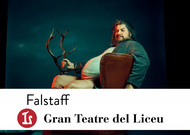





Comments