


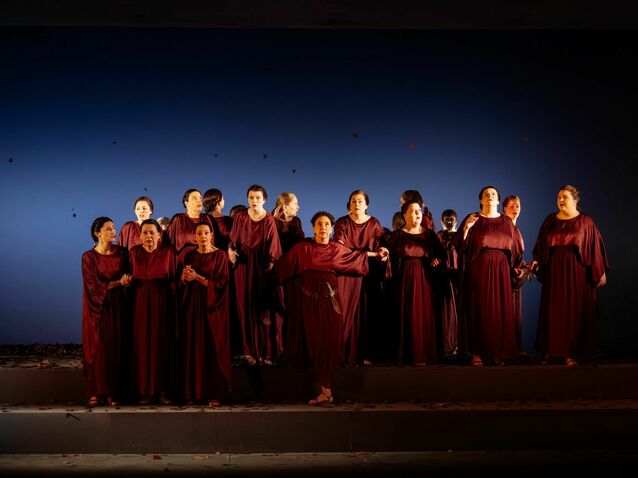
 © ENO / Helen Murray
Iphigénie en Tauride of 1779 was Christoph Willibald Gluck’s fifth and penultimate opera for the French stage. In it he took his ideas concerning reform opera to what might be deemed their logical conclusion, employing récitatif accompagné and largely omitting the dance movements that were a hallmark of French tragédie en musique. Knowing that many of the operas and ballets he had already written in Italian would probably never be performed again, he also recycled a substantial number of compositions from them as a way of keeping the music alive.
Nicolas-François Guillard’s libretto was based primarily on Claude Guimond de la Touche’s spoken tragedy of 1757, whose ultimate source was Euripides’ Iphigenia in Tauris. In direct contrast to Aeschylus’ telling of the wider tale, Iphigénie was not killed on Aulis by her father Agamemnon because, as he was about to sacrifice her, the goddess Artemis replaced her on the altar with a deer, and swept her off to the land of the Taurians. The opera, like Euripides’ play, explores what happens to her there.
Iphigénie is now the high priestess of Diana in the temple of Tauris, but is haunted by a dream in which she saw her mother Clytemnestra murder her father and her brother Oreste kill her mother, before she stabbed her brother. Thoas, King of Tauris, is also preoccupied with dark thoughts, as it is the custom of the Scythians, who inhabit Tauris, to sacrifice anyone who is shipwrecked on their shores, and the oracle has predicted doom if a single stranger escapes with his life.
Oreste and his friend Pylade are shipwrecked on the island. They had come to retrieve Diana’s statue, and Thoas, even though he remains unaware of this, orders them to be sacrificed. As Oreste and Pylade languish in chains, Oreste is tormented by visions of the Furies, who wish to avenge his slaying of his mother Clytemnestra, whom Oreste had killed for murdering his father Agamemnon.
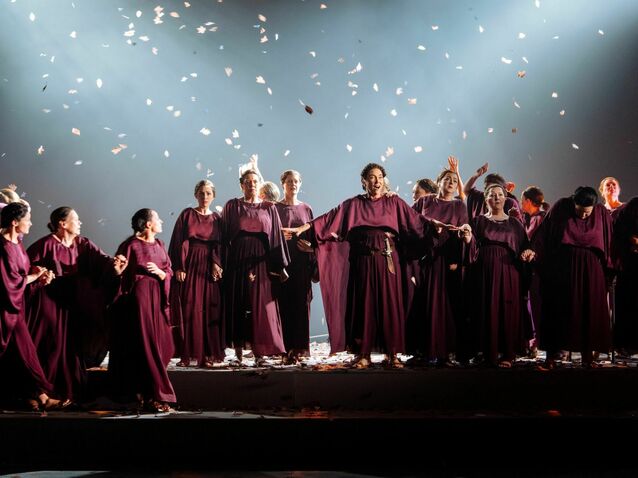
ENO’s Iphigénie en Tauride 2026 © Helen Murray
Oreste tells Iphigénie of everything that has happened in Greece, such as the deaths of Agamemnon and Clytemnestra. She finds herself drawn to the stranger, who reminds her of her brother, but she does not realise that he actually is as he also claims that Oreste died. She tells Oreste and Pylade she can persuade Thoas to save one of them, and asks whoever is spared to carry word of her fate to her sister Electra in Argos. When both men agree, Iphigénie chooses Oreste to live, but Oreste, so distraught at the thought of bringing about his friend’s death, forces her to reverse her decision. Pylade then decides to do everything he can to save Oreste.
Oreste is prepared for sacrifice, while Diana wonders how she could ever bring herself to kill him. On the altar, Oreste cries Iphigénie’s name, leading her to recognise him and to stop the ritual slaughter. Thoas arrives insisting on the death of both Oreste and Iphigénie, in revenge for Pylade’s escape, but then Pylade enters with a band of Greeks, who cut him down. Finally, the goddess Diana appears, who orders the Scythians to restore her statue to Greece. She also pardons Oreste for murdering his mother, and commands him to be king over Mycenae and to restore Iphigénie to her country.
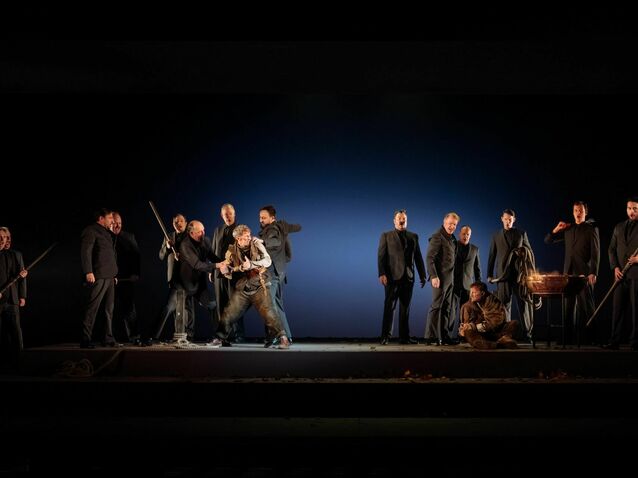
ENO’s Iphigénie en Tauride 2026 © Helen Murray
Contrary to the vast majority of pieces presented by English National Opera, this new production of Iphigénie en Tauride is sung in its original French language, and director Lyndsey Turner overcomes the problem of the London Coliseum stage arguably being too large for the work. Designer Soutra Gilmour places a low roofed ‘frame’ on the stage, which restricts the overall area in which the drama takes place. The men’s costumes are broadly modern, though they brandish ‘primitive’ weapons, while the women’s robes feel more traditional. Strictly speaking, we would have to say we are in the twentieth century as the large tubs and trolleys on castors with which the women do laundry appear to come from then. However, the era we are in is deliberately kept vague, with the important point about the women doing laundry being that, even when they are supposedly in revered positions such as priestesses, they are in reality being exploited.
Shadows appear on the walls, courtesy of lighting designer Tim Mitchell, while a young Oreste and Iphigénie (who also sings as Diana at the end) sometimes appear. Oreste sees them playing at being kings and queens during his vision, before the boy moves to kill the girl, which ties in with the fact that Oreste sees in Iphigénie an astonishing likeness to the slain Clytemnestra. At the end of the evening the tableau formed between Iphigénie, Oreste and Pylade is highly moving.
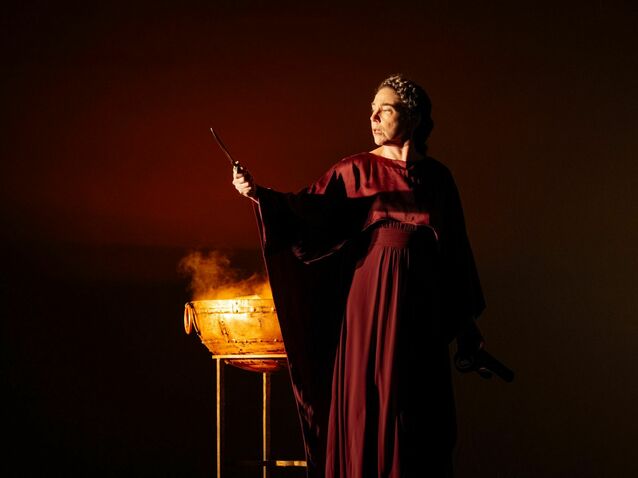
Christine Rice, ENO’s Iphigénie en Tauride 2026 © Helen Murray
At the same time, having all of the drama play out in the same restricted area does not always pay off. Some of the moments involving mass movement feel a little unfocused, and, with everything occurring in the same space, psychologically it is not easy to grasp the moments of high drama or outstanding emotional weight because everything feels too much on the same level. While the aim is clearly to maintain the intensity throughout, in line with the aims of reform opera, it sometimes feels as if the opposite is achieved. Rather than everything being elevated to the level of the overwhelming and truly dramatic, it becomes hard to feel that those occasions that really should stand out rise above the general tone that has been set by the rest of the evening. Under such circumstances, a few moments such as Pylade preparing to leave by changing his trousers, and the striking down of Thoas at the end, feel comical in a way that does not seem particularly helpful.
Nevertheless, the cast is deeply engaging with Christine Rice as Iphigénie revealing a rich and sumptuous mezzo-soprano that still succeeds in bringing great clarity and a certain gleam to her lines. As Oreste, Jacques Imbrailo’s tenor possesses a notable warmth, but is so strong and secure that it can always shape phrases to have maximum emotional impact. Morgan Pearse is a suitably stern and sinister Thoas, without ever descending into caricature, and asserts his sonorous baritone to tremendous effect. Nick Pritchard reveals a highly pleasing tenor as Pylade, while David Bates’ conducting is extremely intelligent and captures a wonderful sense of line in Gluck’s enticing score.
By Sam Smith
Iphigénie en Tauride | 6 - 14 November 2026 | London Coliseum
the 08 of November, 2026 | Print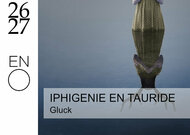






Comments