


 © Ellie Kurttz
Based on Victorien Sardou’s 1887 French-language play, Giacomo Puccini’s Tosca of 1900, with a libretto by Luigi Illica and Giuseppe Giacosa, not only occurs in a specific time and place, but on a precise date that can be linked to an historical event. All of the action takes place during the afternoon, evening and early morning of 17 and 18 June 1800, following the Battle of Marengo between Napoleon’s army and Austrian forces. The Austrians were initially triumphant and sent news of victory back to Rome, but the city’s celebrations were cut short when a later report revealed that Napoleon subsequently mustered reinforcements and actually inflicted a crushing defeat.
Tosca is set across the hours when the contradictory messages arrive in Rome. Angelotti, a consul of the city when it was a republic but a prisoner since Neapolitan forces began to occupy it, escapes from the Castel Sant’Angelo and turns to the painter Cavaradossi to hide him. Rome’s Chief of Police, Baron Scarpia, attempts to squeeze information as to Angelotti’s whereabouts from Cavaradossi’s lover, the celebrated singer Floria Tosca. She is naturally prone to jealousy and Scarpia exploits this, and the situation as a whole, in order to fulfil his own desire for her.
After Scarpia sentences Cavaradossi to death for hiding a fugitive, Tosca promises to give herself to the Chief if he will release her lover and allow both of them to leave Rome. Scarpia agrees, explaining that he still needs to appear to have killed Cavaradossi, and so instructs his agent Spoletta to stage a mock execution by telling him to do as they did with Count Palmieri. As soon as Scarpia has written out their passport, however, Tosca stabs him to death. At the subsequent execution she discovers all too late that the Chief tricked her, and that Cavaradossi was shot with real bullets. As news of Scarpia’s murder spreads Tosca leaps off the parapet of the Castel Sant’Angelo and plunges to her death.

Alaric Green, Chaz'men Williams-Ali, ENO’s Tosca 2026 © Ellie Kurttz
One of the most heart wrenching aspects of Tosca is the very fact that a singer and painter who at the start of the story are simply going about their daily lives should find themselves thrust into a situation that spirals out of control so quickly that within twenty-four hours both are dead. Indeed, whether we assign the point of no return to Cavaradossi’s initial decision to help Angelotti, or to the moment when Tosca determines to head to his villa, which ultimately leads Scarpia’s forces to both men, their fates feel largely sealed by the end of Act I before the sun has even gone down.
Given the specific nature of the background events, Tosca is an opera that many directors choose to set in its original time and place. There are some exceptions to this rule, but most departures, when occurring at all, have not been particularly large. Luc Bondy’s 2009 production for the Metropolitan Opera saw Richard Peduzzi’s sets imply a setting of 1930s fascist Italy, but beyond this did nothing to say we were not in the midst of the French Revolutionary Wars. Christof Loy’s 2022 production for English National Opera, which came from The Finnish National Opera and Ballet, opted for the original setting while also applying a twist. By putting the characters in costumes from a variety of eras, Loy suggested that there have been Scarpias exploiting Toscas at all moments in time, and highlighted the division between Cavaradossi’s revolutionary ideals and Scarpia’s reactionary approach.
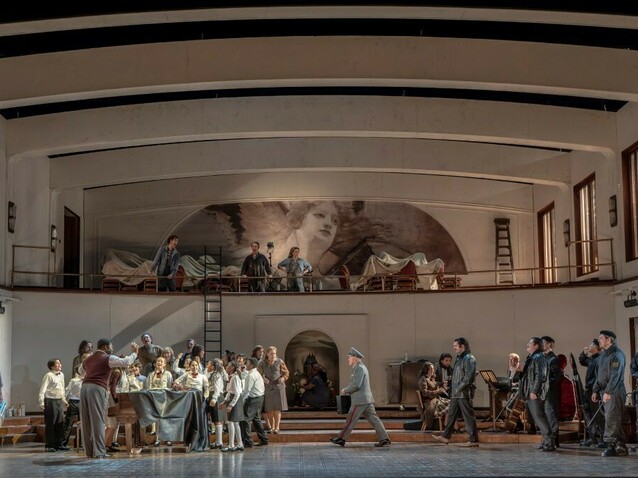
There are, however, productions that have genuinely moved the action forward in time such as Stephen Barlow’s 2008 version for Opera Holland Park, revived most recently in 2024, which set the action in 1960s Rome. Oliver Mears’s 2025 production for the Royal Opera also made a clean break with the original time by setting the piece in the late twentieth century. Annilese Miskimmon’s new staging for English National Opera similarly opts for a 1980s setting in a war torn, and unspecified, Eastern European country that is being ripped to pieces by civil strife and enemies at the borders. The setting for Act I is not a church, but rather a concert hall, and the action remains there for the entire evening. In Rosanna Vize’s set the Coliseum stage predominantly represents the performance space at the top of the hall, with the auditorium it seems stretching out to where the real audience is situated. At the back of the stage is a balcony, and the wall behind this carries the mural that Cavaradossi paints.

ENO’s Tosca 2026 © Ellie Kurttz
To Miskimmon concert halls ‘can hold great beauty and community’, with artists often being the very people who hold out against authoritarianism. At the same time, the arts and music can all too easily be ‘commandeered’ by a dictatorial regime in an attempt to appear legitimate. This would certainly explain why when, as here, other people witness Cavaradossi and Angelotti’s first encounter they do not instantly run to inform the Police because they are liberal artists themselves, and also why Scarpia instructs those in the hall to sing a Te Deum to aid ideas of ceremony and hence respectability. The difficulty, however, is that religion hangs heavy over the entire opera and, even acknowledging Miskimmon’s point that concert halls are ‘secular sacred’ places, reducing its importance affects the overall balance of the piece. Sant’Andrea della Valle, where Act I normally takes place, is a melting pot where Church, Police and State collide, with Scarpia in practice ruling over all three realms. Just because he is far from sincere does not mean religion does not matter to the story, as the whole point is that he hides his cruelty and desire beneath a veneer of piety. Even more importantly, there is a very real sense in which God stands in judgment over the entire scenario, right up until Tosca’s final words ‘O Scarpia, avanti a Dio!’.
It is true that the opera’s themes of love, lust, jealousy, power and betrayal are universal, and hence ones to which we can all relate. However, watching these themes play out in a very real situation such as the original one makes it easier to apply them to our own lives, and the world around us, than when they are rendered virtually in the abstract. With Amanda Holden’s English translation of the libretto removing all references to Napoleon and Melas so that we simply hear that ‘our troops’ lost, the setting feels so vague that it becomes quite unrelatable. This, coupled with the downplaying of the religious aspect that normally exerts such a large force, only adds to a sense of aimlessness.

Axelle Fanyo, Christopher Purves, ENO’s Tosca 2026 © Ellie Kurttz
The production clearly intends to be hard hitting by highlighting the brutality of Scarpia and the regime. However, the opera, which Joseph Kerman described as a ‘shabby little shocker’, is impactful already as the music and characters’ dilemmas are designed to leave the strongest impression. Here, the Te Deum, which should engage us in a very visceral way, hardly feels as if it is taking centre-stage when the sight of Angelotti’s sister being beaten diverts attention away from it. As Tosca sings ‘Ah! Più non posso!’ her complete sense of despair, which should feel so all embracing, is undermined by Scarpia smashing a violin. Act II suffers in particular because what is supposed to be a hushed affair between a few individuals in the dead of night feels swamped by other activity, making it hard to focus on the characters who should stand at its very centre.
Musically, the evening fares better. As Cavaradossi Chaz'men Williams-Ali reveals a warm and aesthetically pleasing tenor, while Axelle Fanyo gives a highly committed performance as Tosca as she offers a strong and accomplished soprano. Christopher Purves is a suitably sinister and malevolent Scarpia (he shares the role across the run with Craig Colclough), and he asserts his baritone to tremendous effect. Too often, however, the principals’ performances are adversely affected by directorial decisions that see Williams-Ali have to deliver ‘Recondita armonia’ and Purves his part in the Te Deum from the balcony. It is particularly hard to project across the entire auditorium from this position, far back and high up the stage, and it creates a special problem for Purves whose voice has to be heard over so many others. The one unqualified success of the evening is Ben Glassberg’s conducting of the Orchestra of English National Opera, as he captures both the detail in, and overall sweep of, Puccini’s score, while also creating that vital sense of urgency.
By Sam Smith
Tosca | 30 October - 11 December 2026 | London Coliseum
the 01 of November, 2026 | Print






Comments