


 © Liceu / A. Bofill
An opera does not have to apologise for not being a Shakespearean tragedy. Vincenzo Bellini’s I Capuleti e i Montecchi shares its protagonists and tragic ending with the English playwright’s drama, but belongs to an earlier Italian tradition that had already shaped the story of the two lovers. It is not an adaptation of Shakespeare that should be judged by its fidelity to the original, but another way of telling a story that has taken many forms. To compare the two as though the opera had to compete with Shakespeare’s tragedy is to start on the wrong foot.
The circumstances in which the opera was composed help explain the unevenness of its score. Bellini had little more than a month to prepare the work for the 1830 Carnival season in Venice, and reused a considerable amount of music from Zaira, which had failed the previous year. He also adapted Giulietta’s aria ‘O quante volte’ from his early opera Adelson e Salvini. Felice Romani, for his part, revised for Bellini the libretto he had written for Nicola Vaccai’s Giulietta e Romeo. Reusing material was common practice in opera at the time. Musically, the result is an uneven work: alongside conventional passages are moments of extraordinary beauty, in which Bellini already discovers that suspended, almost unreal melodic line that would become one of his hallmarks.
The score lacks the lyrical impetus and musical variety of the composer’s finest operas. The purely orchestral sections are often unremarkable, without Rossini’s effervescence or the lyrical sweep of the Verdi who was to come. Yet the orchestra takes on a different role when accompanying the singers: the arpeggiated writing becomes a delicious cushion, supporting and enveloping the voice without competing for the limelight. Riccardo Frizza, who made his Liceu debut with this very opera ten years ago, demonstrated his command of the late bel canto style. He knew when to bring the orchestra to the fore and when to draw it back, allowing the voices to unfold naturally. The woodwinds were particularly fine, with notable moments of refinement from the clarinet and flute, as well as from the horn.
I Capuleti e i Montecchi - Gran Teatre del Liceu (2026-2027) (c) A. Bofill
Lisette Oropesa began the role of Giulietta with a certain tension, understandable on an opening night, but gradually relaxed as the performance progressed. The American soprano has the right qualities for this repertoire: a lyrical, flexible voice, capable of shaping phrases with delicacy. Bellini, however, seems to demand an impossible voice, one that has no weight, that floats and traces a continuous, ethereal line. Oropesa was very, very good, but she was not a dream Giulietta. Dreams, by definition, are difficult to attain.
Raffaella Lupinacci, making her Liceu debut as Romeo, was one of the evening’s great satisfactions. The Italian mezzo-soprano knows the role well, and demonstrated as much from the outset, with vocal assurance and a convincing stage presence. She grew even further as the evening progressed. She is a singer at a particularly fine point in her career, with a well-established voice and such a firm grasp of the character that one hopes to see her back at the Liceu.
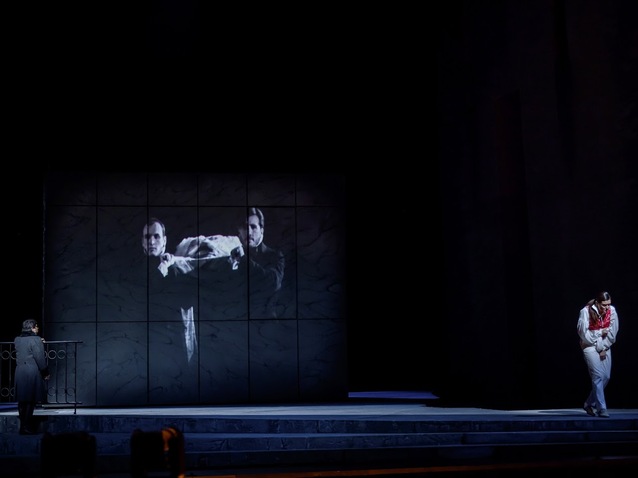
The decision to assign Romeo to a mezzo-soprano rather than a tenor is one of Bellini’s happy inspirations. The combination of Romeo’s and Giulietta’s voices produces a particularly beautiful blend of timbres, which at times recalls the duets between Norma and Adalgisa. The voices seem to merge without losing their individual identities, and this closeness of sound lends an intimate dimension to the lovers’ relationship. One detail is worth noting: amid otherwise rather nondescript costumes, Romeo’s masculine-cut frock coat stands out. Here is a male character played by a woman, dressed in a garment made from fabric conventionally associated with women’s clothing. This exquisite, intelligent and understated ambiguity of gender is more meaningful than many of the stage director’s ideas.
Iván Ayón-Rivas more than met the demands of Tebaldo. The Peruvian tenor’s timbre is not particularly seductive, but his voice gains considerably in the upper register, which is open, bright and well projected, and which he exploited effectively. Tebaldo is not a role tenors tend to relish: a relatively secondary character in an opera dominated by two female voices. A tenor accustomed to leading roles must accept this subordinate position without reservation. Ayón-Rivas rose to the challenge with assurance, bringing an energy to his appearances that contrasted with the lovers’ more restrained manner.
The two basses were considerably less convincing. Alejandro López made a poor start as Capellio, Giulietta’s stern father, and failed to improve as the performance went on; by the end, his voice was barely audible. It is difficult to find much to praise. Marko Mimica, who has given good performances at the Liceu, was equally unconvincing this time as Lorenzo. The doctor takes the place of the friar in the literary tradition: a paternal, benevolent figure who protects the lovers. The role calls for a voice capable of conveying comfort, warmth and trust. Mimica’s sounded strained, constricted and stylistically inappropriate, lacking the naturalness the character requires. These may be secondary roles musically, but not dramatically: both are crucial to the development of the plot. It is not enough to walk on stage and deliver the words: they must be sung, and sung well.
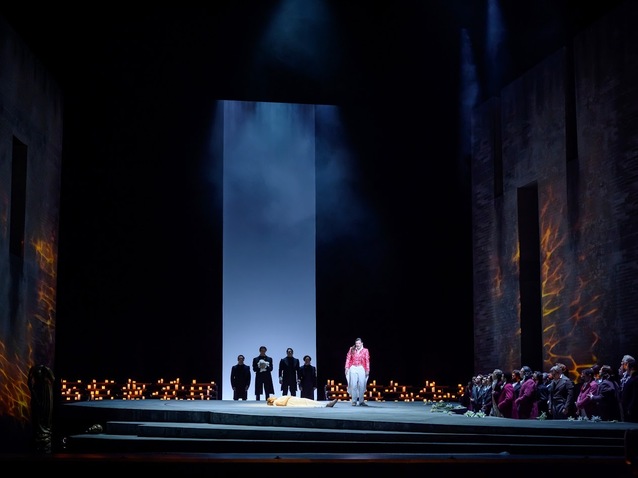
The Liceu chorus, which has a substantial part to play throughout the opera, performed adequately, although this was not one of its finest evenings. Perhaps the nerves of the opening night took their toll here, too. The score doesn’t contain Bellini’s most inspired choral writing, and the stage arrangement did little to help. The raised central platform, reserved for the soloists, left the chorus with too little room, and the singers often seemed to get in one another’s way. The result was distinctly uncomfortable, as though the chorus were simply in the way on stage.
I Capuleti e i Montecchi - Gran Teatre del Liceu (2026-2027) (c) A. Bofill
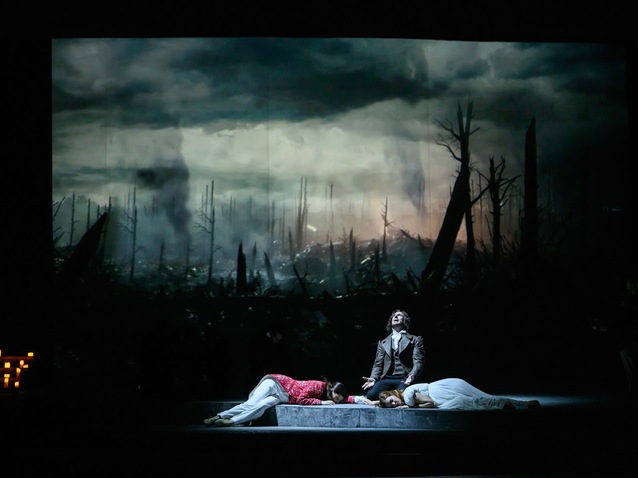
The production from the Opéra Royal de Wallonie-Liège, directed by Allex Aguilera, relocates the action to 1830, the year the opera was composed, but the change of period brings no particularly revealing dramatic interpretation. The set, grey and functional, could serve any number of other operas. The lighting is good, the projections do their job, and the direction of the actors raises no serious problems, but neither does it reveal anything new.
There is a certain insistence on having Romeo and Giulietta end up lying on the floor. Since there is not a single chair on stage, they do not have much choice. A contemporary stage convention that, through sheer repetition, has acquired an inadvertently comic edge. At the centre of the set there is also a revolving cube, one of those devices that seem to be capable of doing everything and often do very little. Thirty years ago, it seemed that every opera had to have a staircase; now it seems that none can do without a cube that revolves and turns into a wall, a room or a projection screen. The device is not inherently bad, but its ubiquity has turned it into a cliché. And the short ballet included in the opera? An extravagant piece of choreography with no dramatic interest whatsoever.
Overall, the production is anonymous and forgettable. And that is the problem: on stage, the one thing you must not be is boring. Better something ugly than something boring. This staging is so bland that in three or four years’ time, when looking at a photograph of it, we may not even remember which opera it belonged to.
I Capuleti e i Montecchiis, in short, a great but imperfect work. It lacks the coherence and completeness of Bellini’s finest operas, but contains moments in which the composer seems to touch a beauty that is almost ideal, one that does not entirely belong to this world. At the Liceu, Frizza’s conducting and the two leading singers, with Lupinacci particularly convincing, allowed us to savour some of that beauty. The production added little, but neither did it prevent the music, whenever it found its way, from fully justifying the revival of a work that does not need to be Shakespeare to possess a value of its own.
Xavier Pujol
Barcelona, 30 October 2026
I Capuleti e i Montecchi, by Vincenzo Bellini. Cast: Alejandro López, bass (Capellio); Lisette Oropesa, soprano (Giulietta); Raffaella Lupinacci, mezzo-soprano (Romeo); Iván Ayón-Rivas, tenor (Tebaldo); Marko Mimica, bass (Lorenzo). Chorus of the Gran Teatre del Liceu. Chorus master Pablo Assante. Orchestra of the Gran Teatre del Liceu. Musical director Riccardo Frizza. Stage direction and set design Allex Aguilera. Costumes Françoise Raybaud. Lighting Luis Perdiguero. Video Arnaud Pottier. Production from the Opéra Royal de Wallonie-Liège. Gran Teatre del Liceu.
the 02 of November, 2026 | Print





Comments