


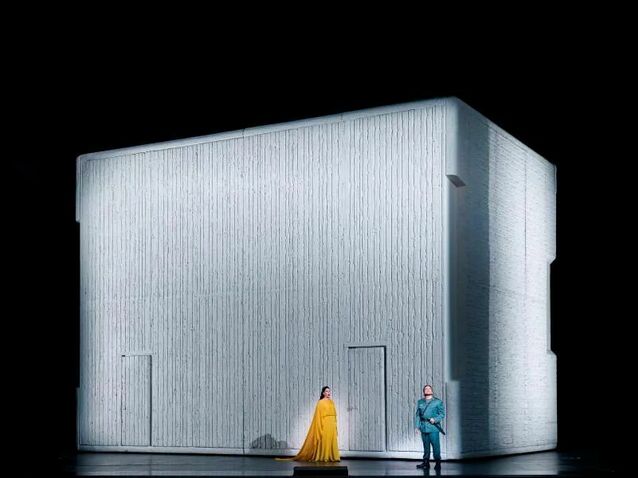
 © Gran Teatre del Liceu / Sergi Panizo
Aida, the opera performed more often than any other at the Liceu, was chosen to open the present season. In that respect, then, there was nothing particularly new. The attraction of this opening-night Aida lay, on the one hand, in Anna Netrebko’s Liceu debut in a staged role and, on the other, in the new production, directed by the Iranian artist Shirin Neshat. This production wasoriginally created for the Salzburg Festival in 2017 and substantially revised by the director herself for its performances at the Opéra national de Paris in 2025.
Vocally, Anna Netrebko is at an ideal stage of maturity for Aida. She retains the beauty and purity of her upper register, her ability to soften the vibratoat the top of the voice, to sing secure diminuendos and to let the sound float without losing its core. At the same time, she now possesses the resources to give the middle and lower registers an appearance of body and solidity which they do not naturally possess, but which are particularly well suited to a role that, although written for soprano, very often requires the singer to descend into the lower reaches of the voice. Netrebko, now 55, is in splendid form and maintained a remarkably high level throughout her exhausting role, without flagging for a moment. She was unquestionably the great triumph of the evening.
Ivan Gyngazov is perhaps a somewhat overly spinto tenor for Radames. His voice is attractive, with a bright, secure and well-placed upper register and magnificent projection. His style could use some refinement, his phrasing often sounds more Puccinian than Verdian. While the voice is quite beautiful at high intensity, it loses some of its interest at medium dynamics. Perhaps this explains Gyngazov’s tendency to overuse the forte. Even so, he deserves credit for knowing how to ‘die’whilst producing some lovely diminuendos in the final duet.
Ekaterina Semenchuk was a very good Amneris, the most multifaceted and complete character in the opera. Her lower register conveys both the authority expected of the humiliated daughter of a Pharaoh and the inner drama of a woman who feels rejected. She struggled somewhat in the upper register, but negotiated it successfully. An experienced singer, Semenchuk knows that Amneris’s success is decided at the end of the opera. She bided her time and gave everything in the final act, where she was impressive.
Artur Ruciński made a good Amonasro, intense on stage and vocally well judged, although a little more vocal weight would have been welcome. Alexander Köpeczi brought gravity and vocal authority to Ramfis; Carmen Buendía was an excellent Priestess; Moisés Marín a convincing Messenger; and George Andguladze sang the King in a manner that made one long for a republic.
The chorus was sensational throughout, and particularly spectacular was the male section in the opening scene at the Temple of Ptah. Aida is a major title for a chorus, and the Liceu’s took every opportunity it was given.
Antonello Manacorda’s musical direction was, overall, good, with fine nuances, particularly in the woodwinds, and a generally well-balanced orchestral sound. The tempi were occasionally slower than the performance tradition of the work would suggest, and there were one or two moments of imprecision in the coordination with the solo voices. Manacorda’s conducting was delicately attentive to an opera that contains far more intimate scenes than might at first appear, while also knowing how to make the more epic and spectacular passages shine.
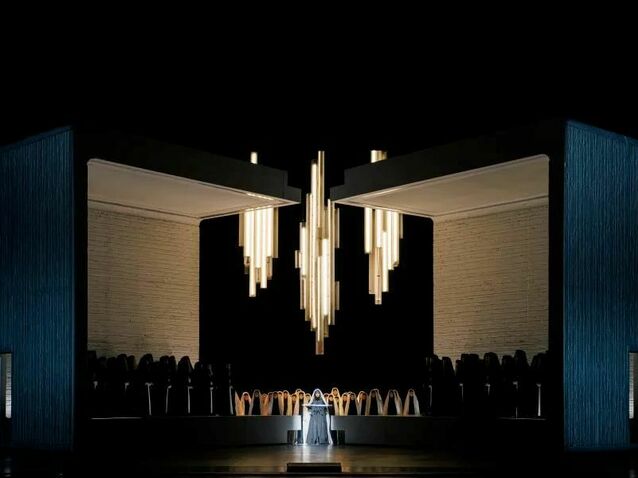
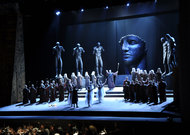
Aida, Gran Teatre del Liceu (2026) (c) Sergi Panizo
The production presented at the Liceu, substantially revised by the stage director from the version shown at the Salzburg Festival in 2017, focuses on the idea that the whole drama of Aida takes place within, and is triggered by, a fundamentalist and militarised theocracy. Indeed, much of what Shirin Neshat proposes is already more than hinted at in the opera’s text. ‘They never have enough blood, yet call themselves ministers of heaven,’ Amneris says to the priests, adding: ‘Infamous tigers, thirsting for blood, you outrage the earth and the gods, punishing those who are innocent.’ If the libretto passed the censors, it was presumably because these invectives were ostensibly directed at the priests of ancient Egypt. But Verdi, who had already presented us in Don Carlo with a Grand Inquisitor who is little short of a psychopath, knew perfectly well where he was pointing.
Neshat extends the criticism to the military establishment and, quite rightly, places the action in a fluctuating time frame which moves into the present for the scenes of violence, while effortlessly retreating into antiquity for the ceremonial scenes, where a contemporary setting would not work.
The main problem with Shirin Neshat’s production is that she is a powerful visual and plastic artist and, in that respect, the production is highly striking — at times almost too much so — but she is not a theatre stage director, and moving characters around a stage is no easy matter. Groups of people are consistently treated as static blocks, while the direction of the individual performers is generally conventional. When it attempts to be ‘creative’, it often makes matters worse, as in the final scene, where Aida and Radamès wander aimlessly around inside the tomb.
Some scenes are very successfully handled, such as the ceremonial symmetry of the Temple of Ptah and the trial of Radames. Others are almost ridiculous, such as the unexpected and unnecessary addition of a goat sacrifice, apparently intended to improve the Egyptian army’s prospects of victory.
Neshat seems to suffer from a kind of stage horror vacui, filling scene changes behind the lowered curtain with strange processions that seem to have little purpose. The first, whose participants might be souls of the damned or priestesses, at least has a certain logic. The second, featuring caricatured soldiers, is grotesque; the third, consisting of zombies in their underpants, is simply ridiculous. None of this was necessary. The striking power of the videos projected on stage, created by Shirin Neshat herself, would have been more than enough.
Christian Schmidt’s set consists essentially of a large revolving cube, ideally suited to the video projections and capable of opening in the middle to create a stage within the stage for the great choral scenes. As so often happens with large-scale sets which, however transformable, rely on a single central element, it works brilliantly in some situations and less well in others. The cube functions perfectly as a temple, but creates an anonymous and uninteresting space for Amneris’s apartments, where the costumes, generally appropriate, are also less successful.
In short: a thoroughly renewed Aida, but one with its share of problems.
Xavier Pujol
Barcelona, 1 October 2026
Giuseppe Verdi: Aida. George Andguladze, bass. Ekaterina Semenchuk, mezzo-soprano. Anna Netrebko, soprano. Ivan Gyngazov, tenor. Alexander Köpeczi, bass. Artur Ruciński, baritone. Moisés Marín, tenor. Carmen Buendía, soprano. Orquestra del Gran Teatre del Liceu. Cor del Gran Teatre del Liceu. Antonello Manacorda, musical direction. Shirin Neshat, stage direction. Dustin Klein, choreography. Christian Schmidt, set design. Tatyana van Walsum, costumes. Felice Ross, lighting. Co-production of the Opéra national de Paris and the Gran Teatre del Liceu, based on the original Salzburg Festival production. Gran Teatre del Liceu.
the 05 of October, 2026 | Print






Comments