


 © Brescia e Amisano
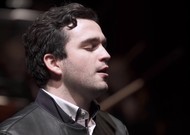
Xabier Anduaga, who in the coming years will almost certainly emerge as a major interpreter of Werther, is not quite there yet. The young tenor from San Sebastián’s debut in the title role was the principal draw of the current run of Werther at the Gran Teatre del Liceu, where the work had not been staged for nearly a decade. The result was an undeniable success, though there remains ground to cover.
Anduaga possesses what matters most for a role that ranks among the most vocally demanding in the French repertoire: intelligence and an ideally suited voice. He brings youth and stamina to an exhausting part, along with a clear, bright, attractive and powerful top register, a solid middle range, and well controlled breath. For his Werther to join the ranks of the truly memorable, however, he must refine his French diction – already good, but capable of improvement – hone his stylistic approach, and enrich his vocal palette. His interpretation, while commendable and at times striking, betrayed a certain “veristic” hardness that sits uneasily with the style. Above all, he must internalise the character more fully, discovering it from within rather than shaping it externally.
The German mezzo-soprano Kristina Stanek, by contrast, had a firm grasp of her role. Fully aligned with the staging concept, she charted Charlotte’s emotional trajectory – from initial restraint to a final outpouring – with steadily increasing intensity and nuance. Though her voice, while more than adequate, is not in itself remarkable, Stanek compensated admirably through a wholly convincing characterisation.
Sophie, a role often overlooked or treated as incidental in traditional productions, here benefited from a more complex and psychologically suggestive development. It was splendidly realised in every respect by the Navarrese soprano Sofía Esparza, making her Liceu debut and clearly a singer to watch.
David Oller proved dramatically effective as Albert, though vocally somewhat underpowered despite improving as the performance progressed. The veteran bass Stefano Palatchi, long a favourite with Liceu audiences, once again acquitted himself well in the role of the Bailiff, as he had nine years ago. Josep Fadó and Enric Martínez-Castignani were delightful as Schmidt and Johann respectively.
The Hungarian Henrik Nánási – a versatile conductor who has led productions at Liceu in recent years ranging from Die Zauberflöte to Cavalleria rusticana and Tosca – offered a competent, workmanlike reading: professional and assured, yet lacking in nuance and brilliance, and missing opportunities to showcase the orchestra afforded by Jules Massenet’s score.
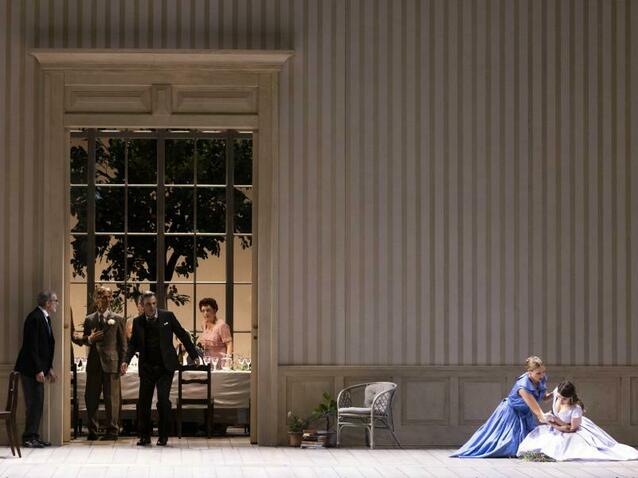
The production itself, a new co-production between Teatro alla Scala and Théâtre des Champs-Élysées, was directed by Christof Loy (revived at the Liceu by Silvia Aurea De Stefano). It featured a sober yet meaningful set design by Johannes Leiacker – which also aided vocal projection – striking costumes for the female cast by Robby Duiveman, and competent though not especially distinctive lighting by Roland Edrich.
Loy’s conception is intelligent, though not among the finest of his work. As is common in many contemporary stagings of Werther, he takes certain liberties with the plot, the most fruitful of which deepen and enrich the characters, lending the impression that one has witnessed an opera with a libretto by Henrik Ibsen or August Strindberg. Crucially, however, he does not distort the fundamental core of this foundational Romantic myth.
Perhaps the most notable aspect of his approach lies in the deepening of Charlotte’s character – the true protagonist of the work – portrayed as a woman torn between duty and desire. Equally striking is the harsher portrayal of Werther himself: still an impassioned idealist, but also an emotionally immature narcissist, absorbed in his own longing and suffering, and largely oblivious to the pain his egocentric behaviour inflicts on those around him.
The stage movement was broadly effective, though inclined at times to unnecessary excess, with characters occasionally perched on tables or sprawled on the floor without clear justification. Loy’s decision to link the third and fourth acts required that, after firing the fatal shot, Werther re-enter the stage under his own power – albeit unsteadily – in order to die during the final duet. The sight of the agonising hero stumbling back onstage drew a ripple of laughter: one of the inevitable trade-offs of modern staging.
Xavier Pujol
Barcelona, 4th may 2026
Werther by Jules Massenet. Xabier Anduaga, tenor. Kristina Stanek, mezzosoprano. David Oller, baritone. Sofía Esparza, soprano. Stefano Palatchi, bass. Josep Fadó, tenor. Enric Martínez-Castignani, baritone. Orquestra del Gran Teatre del Liceu. Cor Vivaldi – Petits Cantors de Catalunya . Henrik Nánási, conductor. Christof Loy, stage director. Silvia Aurea de Stefano, director of restaging. Johannes Leiacker, scenography. Robby Duiveman, costumes. Roland Edrich, lighting Coproduction by Teatro allà Scala and Théatre des Champs-Élysées. Gran Teatre del Liceu.
the 06 of May, 2026 | Print



Comments