


 © Mihaela Bodlovic
Camille Saint-Saëns’ Samson et Dalila, which premiered in Weimar in 1877, is the only one of the composer’s operas to be regularly performed today. In describing how the Israelite Samson is duped by the Philistine Dalila into divulging the secret to his strength, thus enabling him to be weakened and blinded, the story comes from Chapter 16 of the Book of Judges. However, it concentrates on certain elements and downplays others, ignoring the heroic deeds that earned Samson fame among the Hebrews, and focusing on how he is manipulated by Dalila. By presenting the Israelite as an inspiring leader, as opposed to an almost supernatural hero, it reveals how his tender heart is susceptible to her protestations of love, while she is portrayed as conniving and totally bent on revenge. In the opera the revelation that Samson’s strength resides in his hair actually occurs offstage, while it also includes some material not found in the Bible such as the death of the Philistine governor Abimélech in Act I.
Comprising three acts and four scenes, the opera is highly similar to an oratorio in terms of its dramaturgical and musical plan. In fact, Saint-Saëns originally conceived the piece as one, but when he approached Ferdinand Lemaire, the husband of one of his wife’s cousins, about writing a libretto for it, Lemaire convinced the composer that the story was better suited to an opera. The fact that, in practice, it feels as if it falls somewhere between the two does not make it particularly easy to stage because different techniques can be required to convey various parts of it, thus hindering the presentation of a consistent world. There is also the persistent risk of presenting a stereotypical image of ‘Orientalism’. Director Richard Jones always seemed aware of such dangers, but the ‘solutions’ that he implemented in his production, which premiered at the Royal Opera House in 2022, sometimes created problems of their own. Four years later, however, with Benjamin Davis as the revival director, they have been overcome to a large extent. The staging still might not be described as vintage, but it has its merits, and when, as here, it combines with some outstanding musical performances, the results are worth seeing.
ROH Samson et Dalila © 2026 Mihaela Bodlovic
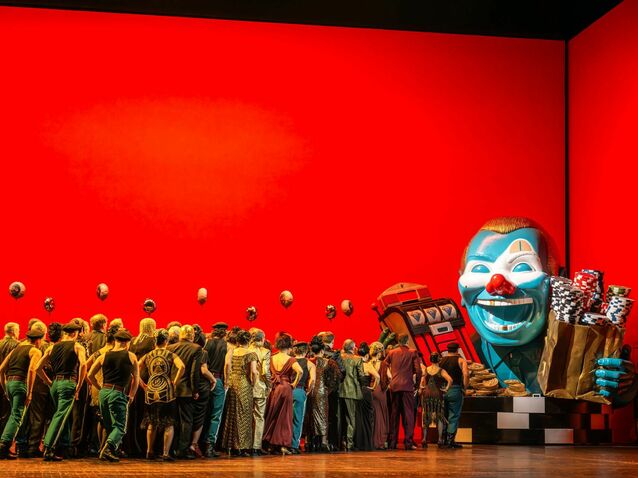
Many of those elements that feel most oratorio-like, given the nature of the music that the chorus sings, appear in Act I, and the accompanying directorial decisions work well as techniques are employed that are often seen when oratorios are staged. On one occasion the entire chorus occupies tiers in a box-like area, thus enabling its members to sing directly out as if this were a concert while still providing an infrastructure for the drama. On several others they walk in lines as they sing, and they sometimes raise their arms in stylised mass gestures. Nicky Gillibrand’s costumes seem broadly contemporary, but are deliberately unspecific so that the evening explores the oppression of one people by another as a universal theme. In this way, the Prelude sees the Philistines interfering in the lives of the Israelites in ways that could be seen as both petty and brutal as they trash a woman’s shopping.
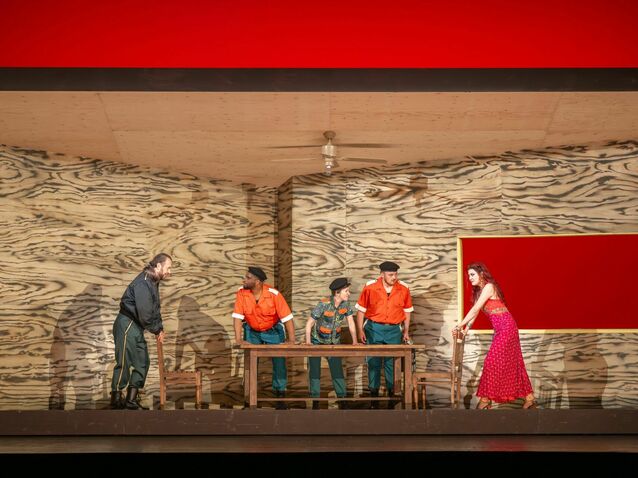
The opera features many scenes that involve just one or two people, and this is where the size of the Royal Opera House stage risks swamping them visually. The difficulty is met by having some scenes take place through windows that appear in a screen that drops down, thus enabling us to home in on the person who requires our attention. There are many telling details as we glimpse activity occurring between scenes as well as during the main encounters. When some of the Hebrew women present Samson with red flowers that colour is mirrored in Dalila’s dress. When the Israelite men try to prevent Dalila from reaching Samson, in a routine originally choreographed by Lucy Burge and revived now by Róisín Whelan, it is less because they fear her corrupting him, and more since they are attracted to her themselves.
The set’s orange back and side walls, however, make the atmosphere feel quite sterile, when that is not what this opera requires, even if it would be equally wrong to indulge in saccharine ‘exoticism’. There are also times when the presence of supernumeraries breaks the spell, such as during the Act II encounter between Dalila and the High Priest of Dagon. The interaction between the pair, which we need to focus solely upon, is undermined by the reactions of the small group of Philistine soldiers who are also present.
Where the production really hits its stride is in the Act II scene between the two main protagonists. Designer Hyemi Shin makes frequent use of a ‘hut’, with action occurring both inside and outside it, and an opening meaning that someone can always be gazing on the scenario. It works particularly well at this point because, by being situated fairly far forward, it ensures the performers are not swamped by a vast area, but without it feeling as if the stage is deliberately being restricted in size.
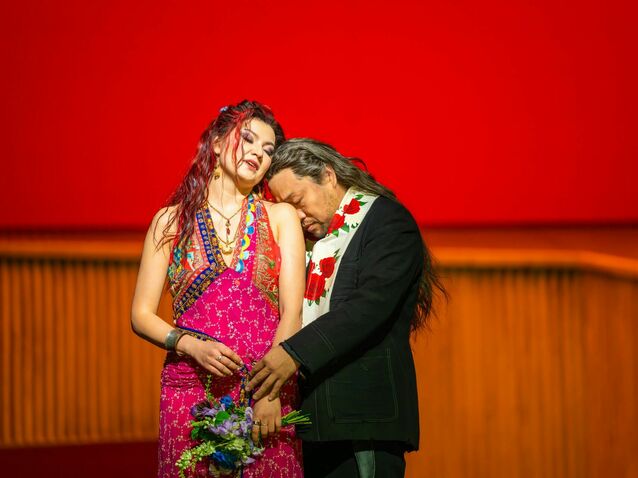
Aigul Akhmetshina as Dalila and SeokJong Baek as Samson © 2026 Mihaela Bodlovic
This is one occasion when the two soloists are surrounded by nobody, and it allows the performances of SeokJong Baek and Aigul Akhmetshina, which are strong all round, to rise to new heights. Baek (Samson) offers an extremely expansive tenor that is also capable of conveying immense sorrow and sensitivity. Akhmetshina (Dalila) displays a sumptuous and notably dark mezzo-soprano, which is used to devastatingly seductive effect. While both, however, prove that they can assert their voices in the most rousing manner, in this scene they reveal just a degree of understatement. This makes the connection between the two complete and the iconic ‘Mon cœur s'ouvre à ta voix’ especially appealing. In contrast to four years ago when this scene seemed a little anaemic, now it feels perfectly formed.
The second half changes the tone completely as a giant blue head holding a fruit machine and gambling chips is rolled on. This suggests that money is really the Philistines’ god, and it is a very interesting idea. However, to introduce it, or at least only to put it centre-stage, in Act III makes it feel false and incongruent with what has gone before. In particular, even if ones believes that Dalila’s hatred of the Hebrews, concern for her people and desire for revenge all ultimately derive from her own ego, it is still misleading to imply that her motivation is money, especially when the evidence from Act II suggests otherwise.
Nevertheless, the Bacchanale, which sees members of the Royal Opera Chorus executing some relatively complex steps alongside the trained dancers, feels in keeping with the tone that has been set, when in 2022 it seemed just a little too comical for the occasion. Alexander Soddy’s conducting is also excellent, while the supporting cast is strong. As the High Priest of Dagon, Łukasz Goliński uses his superb baritone to suggest a figure who, although ostensibly saddened by the death of Abimélech, is really angry at the insult he has been shown by those he sees as lesser beings. Ossian Huskinson asserts his bass-baritone to tremendous effect as Abimélech, while William Thomas utilises his firm bass to present a convincing picture of the wise Old Hebrew, who acts as an advisor to, and even perhaps the conscience of, Samson.
By Sam Smith
Samson et Dalila | 13 May - 3 June 2026 | Royal Ballet and Opera, Covent Garden
the 15 of May, 2026 | Print





Comments