


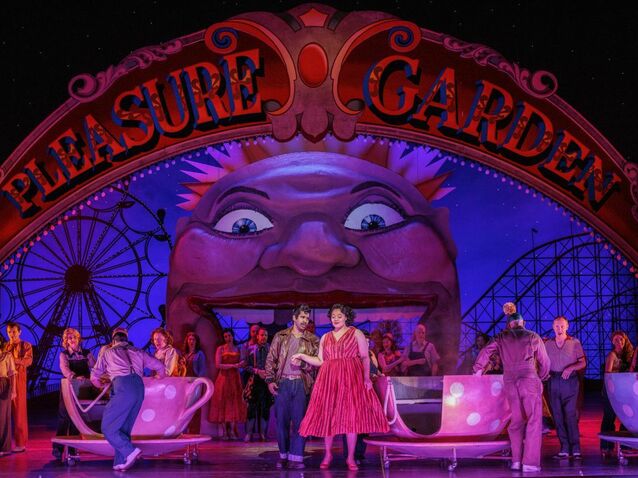
 Così fan tutte © ENO / James Glossop 2026
Originally set in Naples, Così fan tutte of 1790 sees the philosopher Don Alfonso challenge two soldiers, Ferrando and Guglielmo, to prove that their respective fiancées, the sisters Dorabella and Fiordiligi, are faithful. He is certain that no woman ever is, but the younger men are so convinced of their own lovers’ fidelity that they agree to a wager with him. They will pretend to be called away to war and then return disguised as Albanians to try to win over the women, and they consent to doing exactly as Don Alfonso instructs for the period of the bet.
Part of the tension lies in the fact that, on the surface, Ferrando and Guglielmo do not wish to succeed in chatting up the sisters because this would prove what they wish to be the case, and win them the bet. However, especially since as strangers they find themselves attempting to woo each others’ lovers, their desire to think they have the ability to win over any woman takes hold, which means that they start to try increasingly hard. Both women do capitulate, but just when the men are despairing and thinking there is no way they could marry them now, Don Alfonso proclaims that that is how all women are and that this should be accepted and celebrated. As a result, the opera usually has a happy ending, although it is a directorial choice whether to restore the lovers to their original couples or keep them with their newly formed ones. In addition, many productions opt for less cheerful conclusions so that, for example, all of the characters exit in different directions, suggesting that there was never real love between any of them in the first place.
Così fan tutte is the third and final opera (after Le nozze di Figaro and Don Giovanni) on which Mozart collaborated with the librettist Lorenzo Da Ponte. The evidence suggests, however, that in this instance Da Ponte did not originally write the libretto for Mozart, but for the Habsburg’s Court Composer in Vienna, Antonio Salieri. The pair had enjoyed great success with the second version of Salieri’s La scuola de’ gelosi in 1783, and, although the two operas do not involve the same characters, it seems that they were attempting to cash in on its popularity by producing what they could publicise as a ‘follow-up’ entitled La scuola degli amanti (which is now the subtitle of Così fan tutte). Only it seems after Salieri lost faith in the idea, with no more than a few sketches for two trios in his hand surviving today, did Mozart take it on.
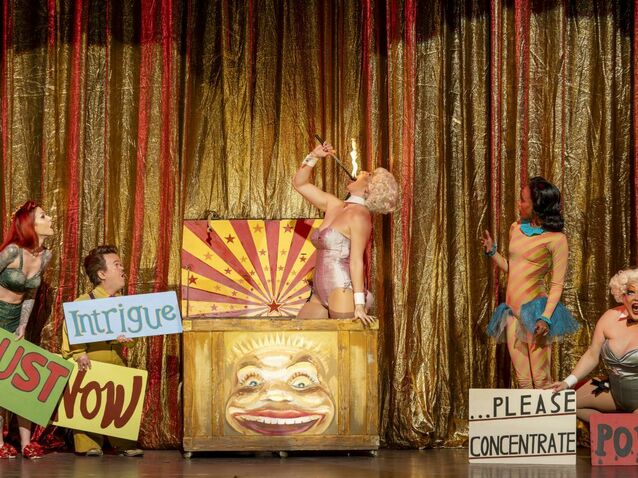
Skills Ensemble, ENO’s Così fan tutte 2026 © James Glossop
Styles of production for Così fan tutte tend to come in waves. For a long time, many were set in the modern day and this approach was epitomised by Jonathan Miller’s erstwhile version for the Royal Opera, which included mobile phones and laptops. However, while such items felt highly novel in 1995 when it premiered, and said something about the class of people who possessed them, by the time of the final revival in 2012 everyone both had them and had seen them a thousand times before in operas.
With even updates of this nature now feeling tired, many new productions have taken another road. This is to set the drama in something akin to a fantasy realm, on the premise that that is what the opera thrusts the quartet of lovers into. Jan Philipp Gloger’s production for the Royal Opera, originally seen in 2016, used the setting of a theatre, while Phelim McDermott’s version, a joint venture between English National Opera and The Metropolitan Opera that first appeared at the London Coliseum in 2014, sets the drama on Coney Island in the 1950s. To McDermott, amusement parks take us into a different world with their magic, exuberance and allure, and it is this type of territory that the lovers enter as they all go on their extraordinary adventure.
To this end, a skills ensemble is introduced comprising strongmen, fire eaters and sword swallowers, with the performers, who include contortionist Tommaso Di Vincenzo and burlesque artist Lilly SnatchDragon, all being at the top of their field. In this way, Don Alfonso becomes almost a ringmaster who assumes the dual roles of conjuror and compere. He is the former in that he, in a sense, ‘conjures up’ the whole scenario, and the latter in that he has to keep the show moving in the right direction. A real compere cannot control what happens in an act once it has started, but at its end must frame whatever has befallen and adjust accordingly to ensure that everything proceeds smoothly. Here, as many scenes end, a golden curtain drops to reveal Don Alfonso, surrounded by his ‘entourage’ of circus performers, reflecting on the situation and introducing his next steps as he might the next routine. The idea works particularly well in this revival thanks to the portrayal of Don Alfonso by Andrew Foster-Williams, who asserts his splendid bass-baritone to excellent effect. While some Don Alfonsos seem to ‘sail’ through the opera, always appearing calm and collected, Foster-Williams often appears quite rattled and anxious during the scenes, thus emphasising his need to ‘regroup’ in between them in order to stay the distance.
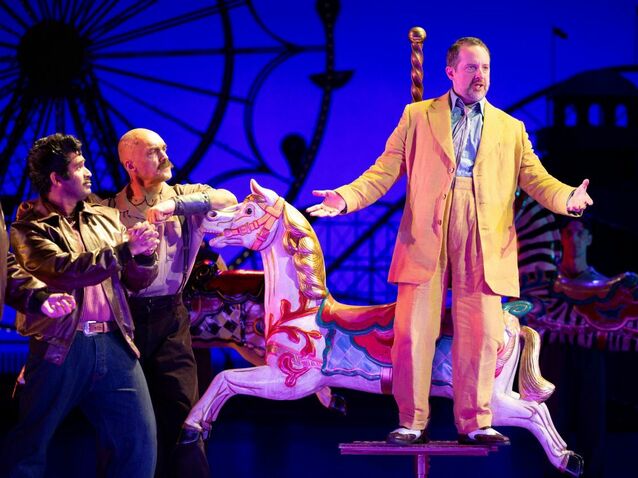
Darwin Prakash, Duncan Meadows, Andrew Foster-Williams, ENO’s Così fan tutte 2026 © James Glossop
The concept lends itself to moments of great dynamism such as during the Overture when Don Alfonso and the maid Despina call up the circus performers to tell us with signs that the opera is about to start and to be prepared for love, lust, lies, intrigue, poison, big arias and chocolate! There is a tension, however, between this approach and the fact that much of Così, which is predominantly about six people, is played out in arias and intimate moments that do not lend themselves to grand visuals. This production recognises this and does not strive to incorporate the performers into every scene, but it can fall between two stools. Sometimes so much goes on in scenes that it proves distracting, but because such dynamism is not sustained from start to finish, the circus elements there are can feel like an add-on rather than essential to the evening.
We do see some fire eating and sword swallowing, but considering the skills these performers possess it seems a shame to reduce their role in Act I’s Finale to little more than falling over like dominoes, as they spend most of the scene merely acting as observers. When Guglielmo gazes distraught on Ferrando and Fiordiligi’s liaison, the fact that a dozen or so circus performers are similarly watching it dilutes the impact of his personal response to the ‘crisis’. Nevertheless, having the circus performers stare at the characters in scenes when they are at their most vulnerable is about as dark as this production gets. The opera can have extremely cruel undertones, and, though it may be presented in many different ways, one cannot help feeling the chosen approach should have played these up more because, behind all of the glitz and glamour, fairgrounds can be sad and dangerous places themselves.
The staging can still be counted as a success, and it looks delightful as Tom Pye’s sets see the lovers ride on teacups, carousel horses and swans, with the circus performers moving the teacups so that they follow the same trajectory as they would on a real functioning ride. Fiordiligi rides the pod of a ferris wheel as she sings ‘Per pietà, ben mio perdona’, showing how, even in a fairground surrounded by thousands of people, she can reflect on her sense of guilt from quite an isolated position.
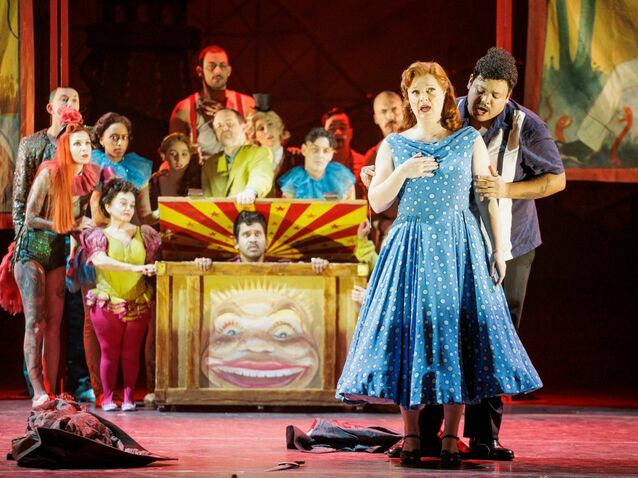
ENO’s Così fan tutte 2026 © James Glossop
The present cast works especially well with the production, making this revival arguably the strongest yet. Lucy Crowe, with her highly accomplished soprano, is a first rate Fiordiligi, while Taylor Raven as Dorabella reveals a mezzo-soprano that positively glistens in its sumptuousness. Joshua Blue displays a beautifully expansive tenor that gives Ferrando just the right sense of vulnerability, while Darwin Prakash, who played Marcello for Longborough Festival Opera in 2024, reveals a notably warm and engaging baritone as he suggests a Guglielmo who thinks rather too much of himself. Ailish Tynan goes to town on playing Despina with her highly persuasive soprano, and a range of accents and costumes, courtesy of Laura Hopkins. Conductor Dinis Sousa takes the score just a little on the slow side, but this is quite deliberate and part of a meticulous approach that produces great dividends.
The sisters occupy adjacent chalets in a Coney Island motel. This introduces an amusing ‘in one door, out the other’ element, which the performers are able to maximise on with their strong comic timing. The way in which the rooms can rotate to reveal both their interiors and exteriors is similarly exploited. When the sisters burst out of their chalets Don Alfonso ‘innocently’ asks what the commotion is, even though we know he was the one causing it by trying to push the men into them. The attention to detail throughout is also staggering so that when Despina, who here becomes a chalet maid, describes how when one lover has gone you simply replace him with another, she illustrates the point by brandishing toilet rolls that reveal just how cheap and disposable she views men to be.
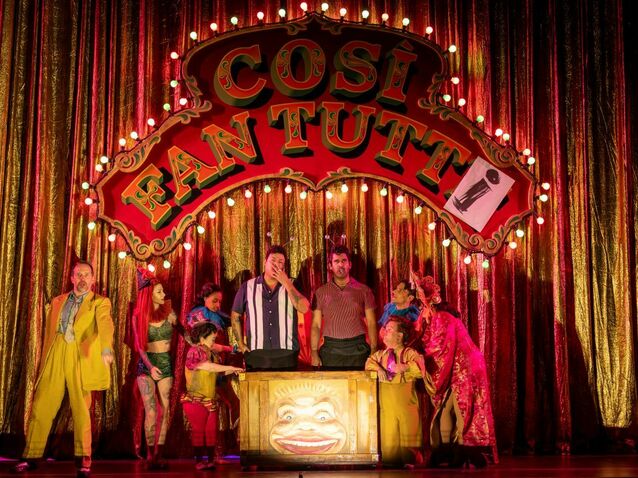
ENO’s Così fan tutte 2026 © James Glossop
The opera’s thesis ‘Così fan tutte’ is generally taken to mean ‘women are like that’, but in Jeremy Sams’ excellent translation it becomes ‘that’s human nature’, ensuring that the point is not made gender specific. At the same time an ‘i’ is placed over the ‘e’ on the words ‘Così fan tutte’ that appear on the golden curtain, thus converting the feminine to the masculine (Jan Philipp Gloger does something similar in his production for the Royal Opera). While, however, this could be seen as a modern day director wanting to place a less misogynistic slant on the work, it could equally represent a point that has always been inherent in the opera. Mozart and Da Ponte may ostensibly have been telling us that ‘women are like that’, while inviting us to infer that ‘men are like that’ as well as in the opera they clearly do not behave any better than the women.
Once the run at the London Coliseum ends, ENO presents a new concert performance of the opera, directed by Ruth Knight and with the same cast of principals, at Manchester’s Bridgewater Hall on 27 and 28 February.
By Sam Smith
Così fan tutte | 6 - 21 February 2026 | London Coliseum
the 08 of February, 2026 | Print




Comments