


 © David Ruano / Gran Teatre del Liceu
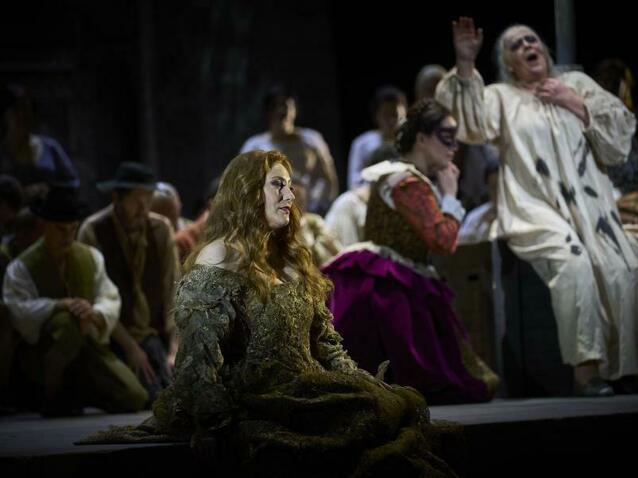
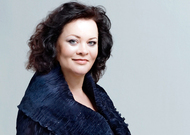
Saioa Hernández has found in the character of Gioconda the role upon which she is building a significant part of her career. She was the most eagerly awaited singer in this new production of La Gioconda, which has just opened at the Gran Teatre del Liceu, and this marks the sixth different staging of Amilcare Ponchielli’s opera in which the Madrid-born soprano has taken part. That is no small achievement, given that the work, though not a rarity, is performed relatively infrequently and that few productions of the title are currently circulating on the world’s stages.
Saioa possesses a true Gioconda voice, a role of exhausting scope and extreme demands for a dramatic soprano; beyond the reach of any soprano who, in addition to secure top notes, does not also command a rock-solid lower register, richly timbred and projected with imposing power, for it is in that range that much is required of her.
Yet Saioa brings more than the voice: she inhabits the character and imbues her with meaning. In the duet with Laura, her rival for Enzo’s love, she became a veritable fury, possessed by jealousy, deliberately seeking in the lower notes an aggressive, even harsh sound to proclaim “Ed io l’amo siccome il leone ama il sangue.” In “Suicidio!”, one of the evening’s most anticipated moments, she was commanding, mastering the sound, controlling phrasing and emission; and when, shortly afterwards, the character is transfigured, redeemed and morally ennobled through her renunciation of love, the voice had shed all hardness and aggression and even acquired a note of sweetness. Saioa Hernández is at present one of the foremost interpreters of La Gioconda.
La Gioconda - Gran Teatre del Liceu Barcelona (2026) (c) David Ruano
In the role of Enzo Grimaldo we heard the American tenor Michael Fabiano, making his debut in the part. Fabiano, too, has an Enzo voice: he ascends to the top register with assurance and courage, produces an attractive timbre and commands a forthright, brilliant emission that already heralds the verismo “spinto” tenor, while still retaining nuances of the lyric tenor. His Enzo is good and will be better still as he continues to perform the part and achieves full command of the character. Enzo’s principal number is the celebrated “Cielo e mar”; on opening night Fabiano had it well in hand when, near the end, a slight roughness in the voice momentarily unsettled him and denied him an unequivocal triumph.
Laura Adorno was ably portrayed by Ksenia Dudnikova. ConfrontingSaioa Hernández in rivalry for the tenor’s love is no easy task, yet Dudnikova did not shrink from the challenge and stoutly defended her position in a thoroughly accomplished performance, both scenically and musically.
Barnaba is a stock villain. Had the librettist, Arrigo Boito, been more cunning, he might have introduced nuance and subtlety into the character’s perversity. Evil, when well drawn, invariably provides rich theatrical material; here, however, that opportunity was missed. Barnaba, the lecherous spy of the Inquisition, is theatrically flat, repetitive and monochrome, and whenever he opens his mouth it is to lie, betray, offend or insult. He is often compared to Iago in Otello, yet Iago (also a creation of Boito) is a true prince of evil, exquisitely twisted and seductively perverse. Gabriele Viviani, who sang Barnaba at the Liceu in 2019, once again defended the role with conviction and theatrical authority; vocally, however, a little more weight and resonance would not have gone amiss.
Weight and resonance were precisely what the bass John Relyea did not lack in the role of Alvise, Laura’s furious husband. He embodies authority, and he sounded every inch the voice of authority.
Violeta Urmana sang La Cieca. The Lithuanian singer must be one of the few women to have sung, over the course of her career, all the principal female roles in this opera: she has been Laura, she has been Gioconda and now, in her artistic maturity, she sustained with great dignity the role of La Cieca, Gioconda’s mother.
The chorus, which began with some ensemble difficulties, gradually settled and ultimately delivered a fine performance in an opera that contains numerous choral passages, though none designed for particular display.
If, dramatically, La Gioconda is a work of such excessive truculence that the plot ultimately becomes an inextricable tangle, populated by characters whose presence on stage is not always convincingly justified, musically it reveals more craftsmanship - solid craftsmanship - than genius. It is more difficult than it is good, and if it remains in the repertoire and appears with relative frequency at Liceu (three productions in twenty years), it is largely owing to its formidable vocal demands.
Daniel Oren, an experienced and versatile conductor, rose to the challenge of balancing these voices against a dense and often heavy orchestral accompaniment without overwhelming them. He skilfully managed the delicate equilibrium between pit and stage and brought out all the nuances- admittedly not overabundant - that the orchestral writing affords.
La Gioconda - Gran Teatre del Liceu Barcelona (2026) (c) David Ruano
La Gioconda was presented in a recent co-production between the Liceu and the Teatro di San Carlo, where it had already been seen in Naples in 2024.
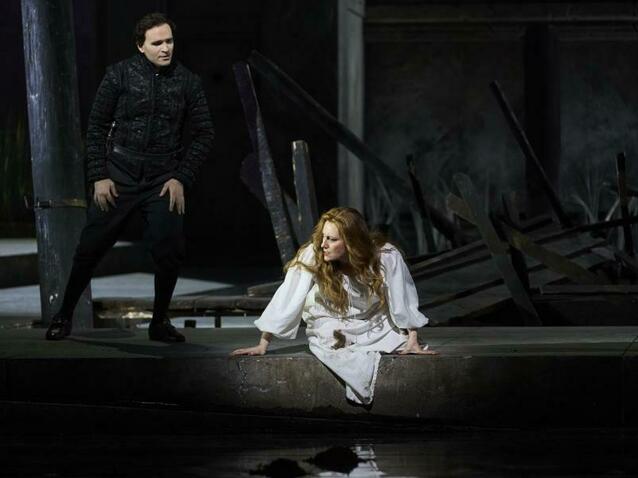
The action of the opera is originally set in seventeenth-century Venice, and the production we saw, directed by the Frenchman Romain Gilbert with costumes by Christian Lacroix, is, astonishingly, also set in seventeenth-century Venice- complete with canals. A genuine novelty.
The production neither reinvents nor abstracts, neither redirects nor reinterprets, nor does it endow the work with new meaning. At most, by progressively soiling Gioconda’s white dress with mud, it subtly suggests that beneath the magnificence of the city of the Doges lies a great deal of physical mud- transmuted, one presumes, into moral mire.
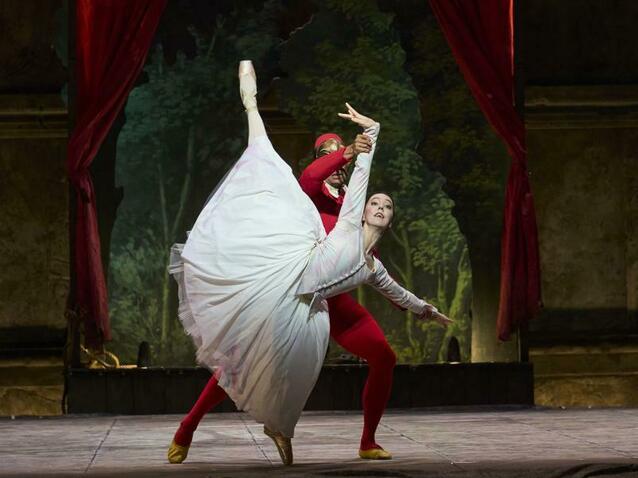
With little in the way of detailed direction of actors, the production places the characters on stage and abandons them there. As the plot is already a tangle in which someone is perpetually lurking behind a column to overhear what ought not to be heard, the staging likewise remains a tangle.It is worth noting that the celebrated “Dance of the Hours” was handsomelyrealised on stage, with a fine choreography by Vincent Chaillet.
It should be made clear that Liceu’saudience, which often expresses its displeasure at the productions presented to it, on this occasion not only refrained from booing but even, with moderation, offered its applause.
Xavier Pujol
Barcelona, 17h February 2026
La Gioconda by Amilcare Ponchielli. Saioa Hernández, soprano. Ksenia Dudnikova, mezzosoprano. John Relyea, bass. Violeta Urmana, mezzosoprano. Michael Fabiano, tenor. Gabriele Viviani, baritone. Orchestra of Gran Teatre del Liceu. Choir of Gran Teatre del Liceu. Daniel Oren, conductor. Romain Gilbert, stage director, Etienne Pluss, scenography. Christian Lacroix, costumes. Valerio Tiberi, lighting. Vincent Chaillet, choreography. Co-production by Gran Teatre del Liceu and Teatro San Carlo. Gran Teatre del Liceu.
the 20 of February, 2026 | Print

Comments