


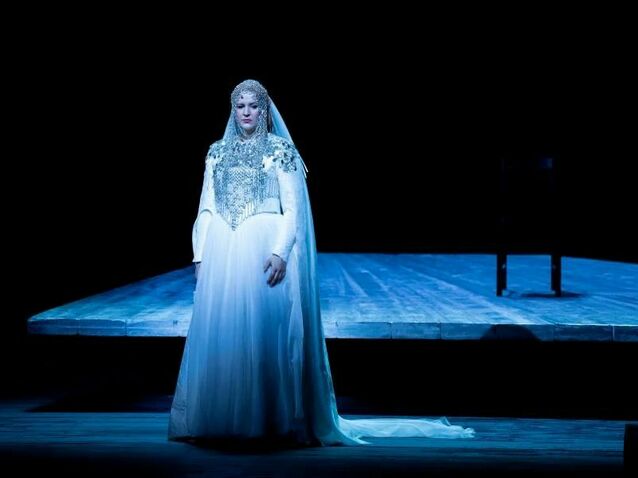
 © Tristan und Isolde, Gran Teatre del Liceu 2026 (c) Sergi Panizo
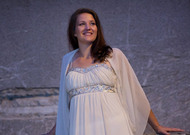
Great expectations surrounded, for several reasons, the premiere of the new production of Tristan und Isolde at Gran Teatre del Liceu. Chief among them was the fact that Lise Davidsen, one of the most highly regarded Wagnerian sopranos of the present day, would be singing Isolde for the first time in her career, one of the most demanding female roles in the operatic repertoire in every respect.
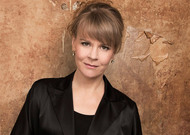
Another source of expectation was that a woman, Susanna Mälkki, would be taking the helm of the Liceu Orchestra to conduct a Wagner opera at the theatre for the first time. The third reason was the unveiling of a new production of the work, directed by Bárbara Lluch, thus completing a female trio in control of the key elements of Tristan und Isolde—the greatest, most mythical, excessive and exhausting (for the audience as well) love-and-death story ever to grace a stage, a benchmark and an unavoidable milestone in the history of Western culture.
Davidsen more than lived up to the high expectations she had generated. There can be no doubt that we are witnessing the emergence of the great Isolde of the coming decade, and one of the finest interpreters ever of this legendary female role. Being able to witness her debut in this character—whom she will present in March at New York’s Metropolitan Opera—was a genuine privilege.
The vocal opulence of the Norwegian soprano is astonishing. When she sings, even in the most demanding passages, she never appears to be anywhere near the limits of her capabilities, whether in terms of range or dynamics; she always seems to have voice to spare. This means that her singing, technically flawless and grounded in impeccably controlled breath support, always sounds ‘comfortable’and is never strident or forced; the tone is rounded, expressive and rich in nuances. Davidsen’s vocal excellence is further enhanced by exquisite musical sensitivity and great stage intelligence, which allow her to remain fully in command of the character at all times. Perhaps in the celebrated final Liebestod there were, on opening night, the slightest signs of vocal fatigue, which will doubtless disappear in subsequent performances and are entirely understandable in a singer who was returning to the stage for the first time after having been absent for almost a year due to maternity leave (she has, incidentally, had twins).
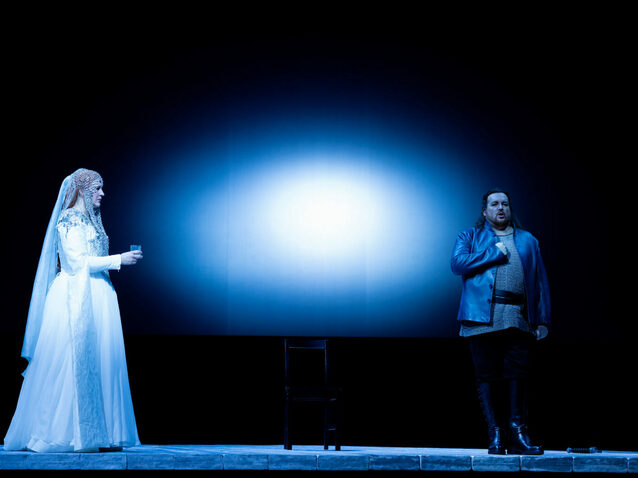
Tristan und Isolde, Gran Teatre del Liceu 2026 (c) Sergi Panizo
The role of Tristan was entrusted to Clay Hilley, an American tenor who has recently been focusing his career with success on the Wagnerian repertoire. Aware that Tristan stakes everything in the third act, Hilley conserved his voice—perhaps too much—in the first, was solid in the second, and was able to display both vocal power and stamina in the gruelling third act. Although he did not always seem entirely comfortable with the characterisation demanded by the production, his Tristan, while not entering the select gallery of historic interpreters of the role, was wholly satisfactory.
Brangäne, an ungrateful role that is highly demanding yet offers few opportunities to shine, was sung by Ekaterina Gubanova, a specialist in the part, who excelled in a spectacular “Habet Acht!” sung from a proscenium box.
Kurwenal, the faithful friend of the protagonist, was performed by the Polish baritone Tomasz Konieczny, who, with a solid and powerful voice, delivered excellently in the third act. The good King Marke, who always arrives too late to offer understanding and forgiveness to the lovers, is a role that must be sung from pain and sadness rather than from any supposed royal majesty. Brindley Sherratt, although his voice showed strain and tension in the ascent to the upper register, was a good King Marke.
Roger Padullés was effective as Melot, Milan Perišić as the Steersman, and Albert Casals was uneven as the Sailor but did better as the Shepherd.
Susanna Mälkki, who was conducting a complete Wagner opera on stage for the first time, led the theatre’s orchestra competently, drawing from it a very high level of performance and demonstrating a clear understanding of what was required. Mälkki’s Wagner is modern: less weight, less density, fewer sonic clouds, and more transparency, detail, clarity, and instrumental differentiation and individuation (the woodwinds were exemplary in this respect), with rigorous dynamic control, expressive use of silence, and the full power of Wagner’s potent orchestration reserved for key moments only. A Wagner far more “chamber-like” than it sounded decades ago. The audience clearly appreciated Mälkki’s work and rewarded both orchestra and musical direction with a resounding ovation.
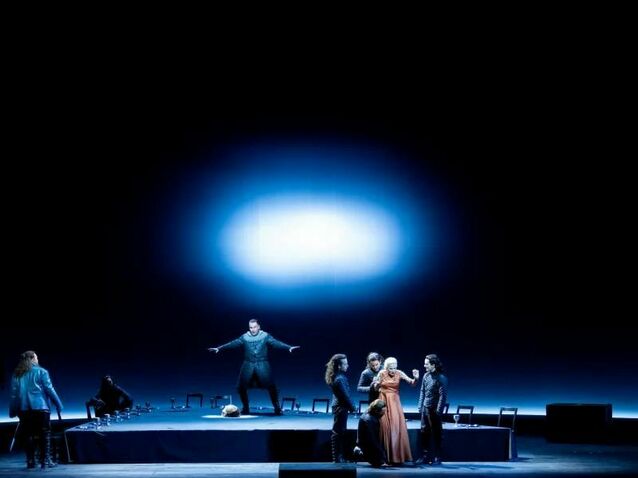
Tristan und Isolde, Gran Teatre del Liceu 2026 (c) Sergi Panizo
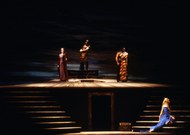
Of the new production, directed by the Barcelona-born Bárbara Lluch, the best that can be said—no small thing in the present climate—is that it is scrupulously respectful of the work and, despite certain additions that seemed entirely beside the point (what was Morold’s severed head doing on the table?), it does not betray the opera in what is fundamental. The worst that can be said of it is that it feels insufficient, underdeveloped and lacking in ideas. It seems that the mythical prestige of the work may have overawed Lluch, leading her to remain in a cautious background- too cautious, indeed.
In Tristan und Isolde, the dramatic core lies not in stage action, which is practically non-existent, but in the psychological evolution of the characters, in their inner journey guided by the music. In this respect, the new production was not particularly successful, as it failed to illuminate that journey.
The set design by Urs Schönebaum, who was also responsible for the lighting, could be framed within a current of abstract minimalism that might only have worked in the context of strong and powerful actor direction, which was absent; as a result, the characters often wandered aimlessly across the stage.
There were, admittedly, some successful moments, such as the revolving platform in the second act during the love duet, which moved the singers without themactually moving and, combined with the starry backdrop, aptly evoked a weightless ballet suspended in space.
The costumes by Clara Peluffo, erratic in intent and entirely at odds with the production, were particularly cruel to Tristan, whose status as protagonist was evident only because he was singing; otherwise, he might easily have been mistaken for an anonymous supporting character.
Xavier Pujol
Barcelona, 12th January 2026
Tristan und Isolde by Richard Wagner. Clay Hilley, tenor. Brindley Sherratt, bass-baritone. Lise Davidsen, soprano. Tomasz Konieczny, bass-baritone. Roger Padullés, tenor. Ekaterina Gubanova, mezzosoprano. Albert Casals, tenor. Milan Perišic, baritone. Orchestra of Gran Teatre del Liceu. Choir of Gran Teatre del Liceu. Susanna Mälkki, conductor. Barbara Lluch, stage director. Urs Schönebaum, scenography and lighting. Clara Peluffo, costumes. Production by Gran Teatre del Liceu.
the 15 of January, 2026 | Print


Comments