


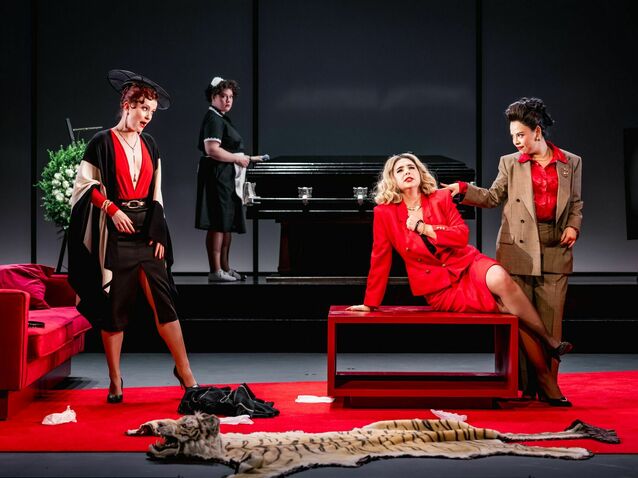
 © The Royal Opera / Mark Senior (2026)
Tales of Love and Loss is not the name of one specific opera, but rather the title given to this triple bill in which all three works have been composed by women. It constitutes a Jette Parker Artist production, meaning the cast and creatives are drawn from the Royal Ballet and Opera’s programme to develop up-and-coming talent, and it is presented in the venue’s smaller Linbury Theatre to celebrate the scheme’s twenty-fifth anniversary.
While the parallels can be overstated, it is easy to think of Giacomo Puccini’s Il trittico when watching this triple bill. True, Il trittico was always conceived as a single entity, while these operas have only been put together in this instance. However, both see all of the pieces work to the same theme, which in the case of the Puccini is the concealment of a death, and in this instance is given away by the overarching title. In both cases as well the theme is so broad that it allows for much variation. The fact that here the operas come from different composers also aids the interest, although one of the unifying factors is the use of the same director (Talia Stern) and performers across the three, so that most play more than one role.
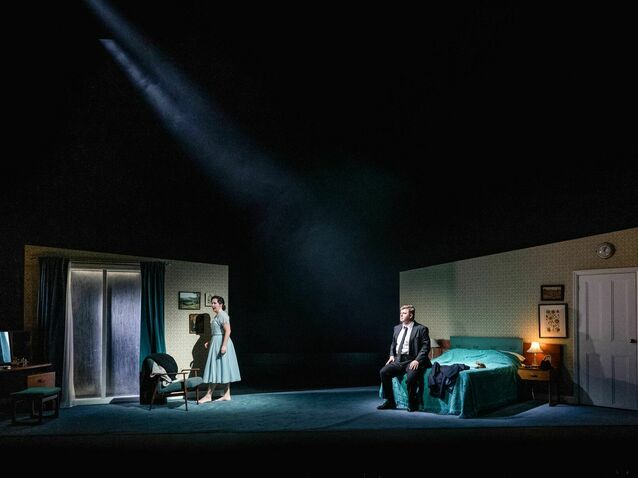
Ellen Pearson as Julia and Sam Hird as Mark in The Departure, The Royal Opera © 2026 Mark Senior
Elizabeth Maconchy’s 1961 opera The Departure, with a libretto by Anne Ridler, is arguably the most interesting of the three from a musical perspective. It sees a woman named Julia look out of the window of her house to see her husband Mark with other people. As she wonders why she is not with him, the truth of the situation dawns on her and, by extension, us. When Mark subsequently enters the house, the pair have to work together to face the separation that they know must come. Julia’s trajectory across the opera sees her move from confusion to realisation to acceptance, although we are left to feel an equal level of sympathy for Mark as the one who is ‘left behind’.
Ana Inés Jabares-Pita’s set presents a standard suburban house in the 1960s, but it is full of atmosphere as lamps flicker in the dimly lit interior and huge shafts of light enter the space when doors are opened. It thus has the overall feel of a Vilhelm Hammershøi painting as typically recreated in the set for an Henrik Ibsen play, only the underlying aesthetic has been brought forward in time by sixty years. The opera provides an excellent opportunity for Ellen Pearson, with her radiant and precise mezzo-soprano, to shine as Julia, while Sam Hird asserts his tremendous baritone to strong effect as Mark.
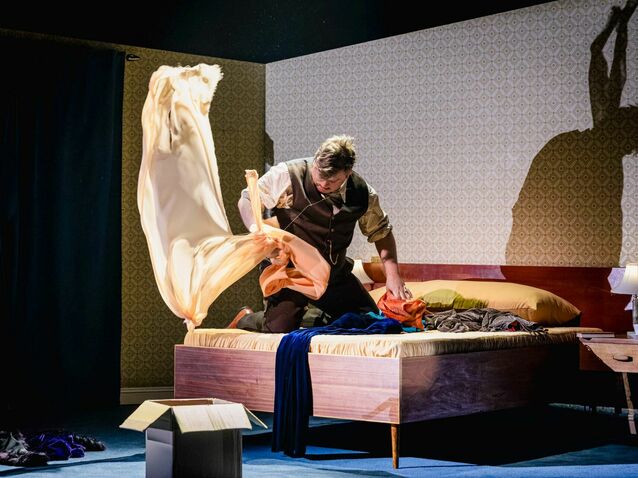
Sam Hird as Hewson Blair in Making Arrangements, The Royal Opera © 2026 Mark Senior
Making Arrangements of 2012, by composer Charlotte Bray and librettist Kate Kennedy, is based on Elizabeth Bowen’s short story of 1925, and is possibly the most thematically rich of the operas. It sees a man named Hewson Blair, whose wife Margery has recently run away to Switzerland with her lover Leslie, receive a letter demanding a divorce and asking him to send on her garments. There are moments when the letter is heard from the multiple perspectives of her writing it and him reading it as Hewson (Sam Hird once more on excellent form) and Margery (a highly persuasive Hannah Edmunds) deliver its words in harmony, although things are set up so that sometimes one of them begins singing a line before the other.
As Hewson starts going through Margery’s clothes he becomes enraged at the thought that he bought them all, and hence, he believes, made her. Taking this logic a step further, and incensed at the idea that she is now sharing her possessions and self with someone else, he concludes that destroying her clothes will destroy her. It makes for a powerful piece of drama, especially since one is left supposing that he overestimates the extent to which he made her, and hence can break her, and wondering if the loss of her clothes really will remove Margery’s independence and result in her returning to him. The same basic set is used as for The Departure, only now the action seems to be set in the 1970s, while there are strong performances from Jingwen Cai and Giorgi Guliashvili in the supporting roles of the Maid and Leslie respectively.
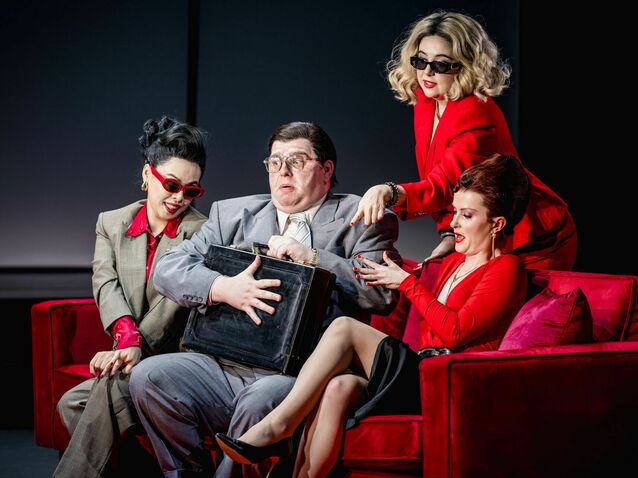
Jingwen Cai, Sam Hird, Ellen Pearson and Madeline Robinson in Four Sisters, The Royal Opera © 2026 Mark Senior
After the interval Elena Langer’s 2012 opera Four Sisters, with a libretto by John Lloyd Davies, is quite a riotous affair. Initially inspired by, but not actually based on, Anton Chekhov’s Three Sisters, it sees the relevant siblings gather after their wealthy father’s death to hear what they have been left in his will. Their gold digging ways, however, are thwarted by a twist, which unfortunately it is quite easy to work out once we compare the set-up with the opera’s title. This makes it feel comparable thematically to the third opera in Il trittico, Gianni Schicchi. Although the execution is quite different in some ways, they both see the final pandemonium give way to a single character (the ultimate beneficiary in both cases) delivering something akin to an epilogue alone on the stage.
The opera is highly entertaining as Langer deliberately incorporates arias in a variety of musical styles. It is delivered with panache by Jingwen Cai, Ellen Pearson and Madeline Robinson who play the sisters, Hannah Edmunds who sings the Maid, and Sam Hird who goes to town in portraying the larger than life lawyer Krumpelblatt. Four Sisters was originally written for a full symphony orchestra, but Langer prepared this chamber version of the score especially for these performances, and the Britten Sinfonia, which constitutes the orchestra for the entire evening, is conducted extremely well by Peggy Wu.
By Sam Smith
Tales of Love and Loss | 1 - 9 May 2026 | Linbury Theatre, Royal Ballet and Opera, Covent Garden
the 03 of May, 2026 | Print



Comments