


 © Tristram Kenton (2026)
Premiering in 1945, with a libretto adapted by Montagu Slater from a section of George Crabbe’s 1810 narrative poem The Borough, Peter Grimes focuses on the type of outsider figure that always fascinated Benjamin Britten. Originally set in a nineteenth century Suffolk coastal village, it focuses on the clash between Grimes, a hard working fisherman who dreams of wealth and respect, and a narrow-minded and repressive community who will never judge him kindly, irrespective of what he actually achieves.
After Peter’s boy apprentice dies while they are at sea, an inquest rules that the death was accidental, meaning he will not face trial. However, the coroner and lawyer Swallow interrogates Peter quite severely before delivering his verdict, and suggests he should not get another youngster as people do not forget incidents like this. Peter protests that he cannot make a living without one, and the schoolmistress Ellen Orford, who loves him, proposes a solution whereby Peter obtains a child and she makes it her responsibility to care for it.
Peter believes that by working hard he will acquire enough wealth to silence all of his critics. He is consequently only willing to marry Ellen when he has gained the respect of the borough, even though it is clear she would gladly wed and care for him now. The difficulty is, as the retired merchant skipper Captain Balstrode knows all too well, that the respect Peter craves will never materialise, while his attempts to gain it could land him in further trouble. Working his new apprentice too hard and beating him, he attempts to go fishing on a Sunday for a large shoal of herring that no one else has spotted. In his forced haste to get to the boat, The Boy slips as he descends the cliff from Peter’s house and dies.
When the community works out what must have happened, they brand Grimes a murderer and attempt to hunt him down. Seeing there is no way out for the fisherman, Balstrode suggests that he drown himself by taking his boat out to sea and sinking it. This Peter does as the unreformed community goes about its normal business once more.
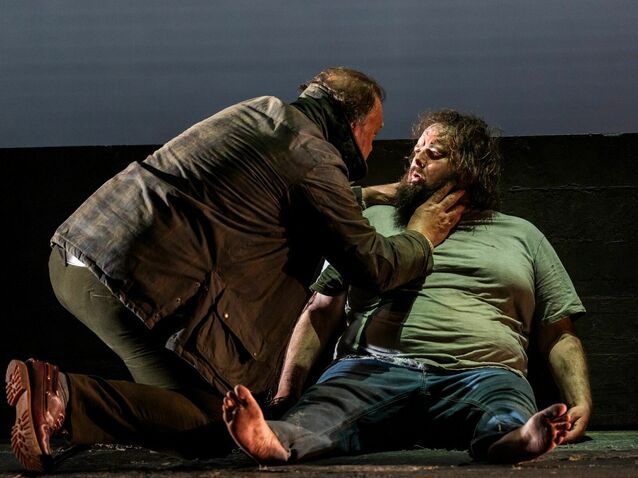
Bryn Terfel and Allan Clayton in Deborah Warner’s Peter Grimes © 2026 Tristram Kenton
Deborah Warner’s staging, which represents a co-production with the Teatro Real, Madrid, Teatro dell’Opera di Roma and Opéra National de Paris, first appeared at the Royal Opera House in 2022, and now returns for its first revival there. It proves to be just as effective as the first time around as it combines a certain realism, which suggests the sweat that underpins Peter’s way of life, with a touch of the ethereal, in line with his ability to dream. When these two elements are put together the resulting staging seems to possess a degree of hyperbole, but it is one that only serves to heighten the drama.
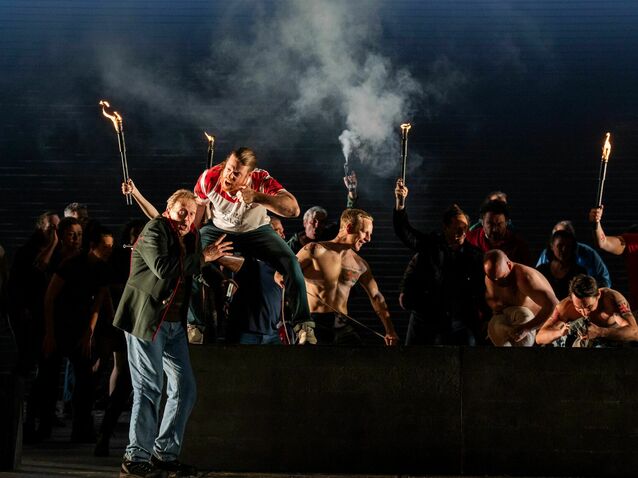
In Michael Levine’s set, the evening begins with a fishing boat hanging over the stage, which could signify Peter’s means to raise himself up or the weight that permanently hangs over him and could crush him at any moment. The opening scene sees the inquest look more like an interrogation as Swallow leans over Peter, who is reduced to rolling across the ground, while the rest of the cast, choreographed by Kim Brandstrup, shine torches on him in the dark. Not only are Peter Mumford’s lighting designs highly effective here, but at this stage the majority of figures appear in silhouette so that our focus is on the whole concept of a repressive community as opposed to the individuals who make it up.
The contrast between the gritty and ethereal is highlighted by keeping the sides of the stage open to reveal the ‘mechanics’ of the staging, while inserting a shimmering image of light falling on the sea, which could have come from the hand of Agnes Martin or Gerhard Richter, as a backdrop. The Boar pub has a sunken floor so that individuals can become more prominent by standing at a higher level to the mass of people who sit beneath them, while the walls of Peter’s house on the cliff recline sharply in keeping with the landslide that is reported to have occurred and the obvious visual requirements for the scene. The setting is the modern day, and breeze blocks and traffic cones adorn the harbour, making it look a tough and ugly place. As a result, while in the original the hard way of life that prevails in the borough derives from its remoteness, here it is attributable to its having been neglected and left behind.
If the community begins as a faceless mass, by the end it feels more menacing and real than it ever normally does in productions. These people do not confront the audience in a stylised manner as they cry for ‘Peter Grimes’ in Act III, but rather feel disturbingly violent as they repeatedly slam an effigy of him to the ground. The atmosphere here is carnivalesque in a grotesque way, while the panting to be heard in the silence between each utterance of the name is tangible.
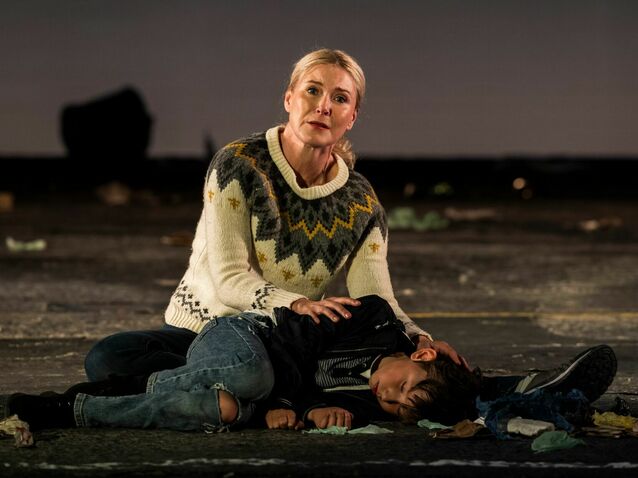
Maria Bengtsson and Johnny Imbrailo in Deborah Warner’s Peter Grimes © 2026 Tristram Kenton
At the other end of the spectrum, the Interludes simply see the curtain fall as the words ‘Interlude I’, and some blue strips of light that signify the sea and sky, appear. This is clever because it allows the music to speak for itself, uninhibited by excessive visual distractions, but the words are just enough to ensure we stay in the same zone as for the surrounding drama, when we would be unlikely to do so if we were left to stare at a blank curtain.
Grimes twice spies the first apprentice (played by aerialist Jack Horner) moving through the air so that he could be either flying or drowning. This highlights the thin dividing line between dreams and despair, and sets up an important relationship between Peter and his apprentices that this production then exploits to the full. The flying device is used sparingly enough to ensure that we do not feel hit around the head with the point it is making, and it certainly helps that the two pieces of music to which the apprentice appears are very different. This enables one appearance to be associated with the nightmare of a storm, while the other allows for more reflection and contemplation on Grimes’s part.
The manner of the second apprentice’s death also highlights the role of the wider community in it. This is because The Boy does not fall because Grimes lets go of the rope, but because he is distracted when he hears the people knocking on the door. It is the opera’s final image, however, that confirms the idea that Peter and his apprentices are ultimately one and the same. Not only do they all end up dead, but each is naive while also being possessed of enormous potential that is never allowed to come to fruition.
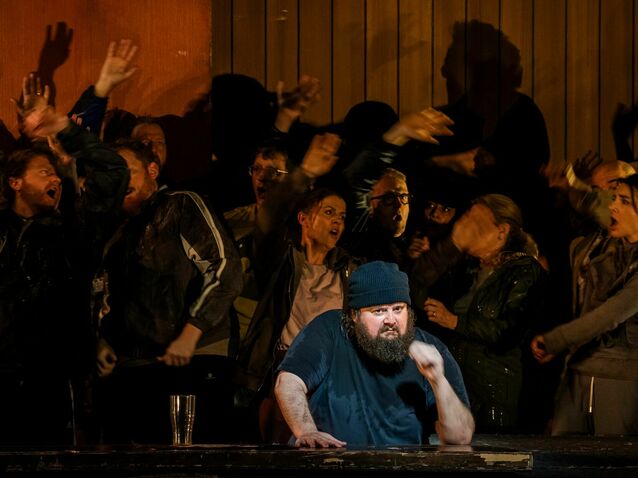
Allan Clayton as Peter Grimes in Deborah Warner’s Peter Grimes © 2026 Tristram Kenton
Jakub Hrůša’s conducting is extremely exciting as he makes the score feel particularly dramatic, while ensuring that the output remains technically and musically precise. The result is a reading that feels as disconcerting as it ever could be without ceasing to be impeccably measured and balanced overall. The cast, many of whose members reprise their roles from four years ago, is strong all round, but two principals stand out in particular. In both cases their singing is first rate, but their performances are enhanced by the sheer presence that they radiate whenever they grace the stage. The first is Allan Clayton in the title role, who asserts his tenor to brilliant effect throughout, and uses it in Act III to convey a man who is so completely lost that he is already entering another realm. This Peter feels especially detached from everything, which is attributable in part to the staging as there is a period in the crowded Boar when he stands completely apart from everyone else, but is mainly down to the persona that Clayton creates. In some respects this Peter’s complete detachment, coupled with his determination to succeed, make him highly unsympathetic, but Clayton’s achievement is still to make us see him as a victim who has been genuinely damaged by the death of his first apprentice, precisely because he feels a connection with him.
Sir Bryn Terfel, with his strong and assertive bass-baritone, is a commanding Balstrode. At the start he shows how he is caring towards Peter by being completely straight with him, and he continually tries to act as a moderating force on the community, while recognising the limits of his ability to transform its mindset. When he gives his advice to Grimes to drown himself one wonders how much he arrived at that conclusion in the moment, upon seeing in Peter’s eyes that he had reached a point of no return. Maria Bengtsson is both a sensitive and radiant Ellen, while there is splendid support from Clive Bayley as Swallow, Jacques Imbrailo as Ned Keene, Christine Rice as Mrs Sedley, John Graham-Hall as Bob Boles, James Gilchrist as the Rev. Horace Adams, Barnaby Rea as Hobson, Catherine Wyn-Rogers as ‘Auntie’ and Jennifer France and Natalia Labourdette as her ‘Nieces’. Finally, Johnny Imbrailo in the silent role of The Boy (one he shares over the run with Toby Higgins) conveys a wide range of emotions in an extremely subtle manner, despite never singing a note.
By Sam Smith
Peter Grimes | 5 - 28 May 2026 | Royal Ballet and Opera, Covent Garden
the 07 of May, 2026 | Print








Comments