


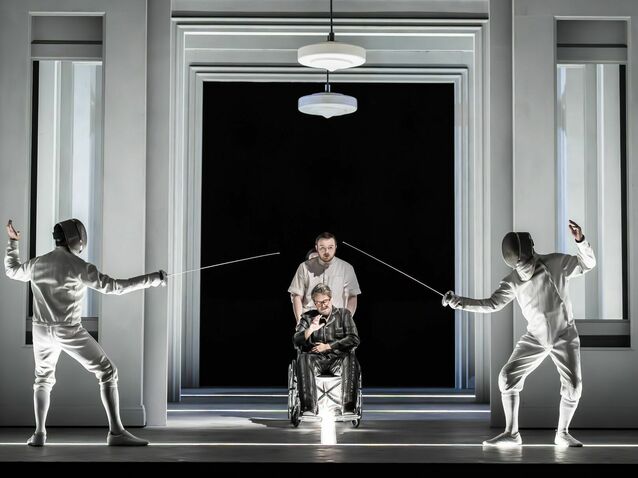
 © 2025 Marc Brenner
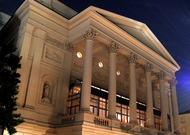
Ariodante HWV 33 is an opera seria in three acts by George Frideric Handel. The anonymous Italian libretto was based on a work by Antonio Salvi, which had itself been adapted from Canti 4, 5 and 6 of Ludovico Ariosto’s Orlando Furioso. It premiered at London’s Covent Garden Theatre on 8 January 1735, and received eleven performances during its initial run. It was revived by Handel for his 1736 season, but then went unperformed until it appeared in Stuttgart in 1926. It has enjoyed more performances over recent decades, in line with a general resurgence of interest in the composer’s operas, but this new staging for the Royal Ballet and Opera represents the first time it has returned to the site of its premiere, notwithstanding a concert performance in 2020 that was designed to be watched online. It represents a co-production with Opéra national du Rhin, where it was seen in November 2024, and Opéra de Lausanne.
Originally set in medieval Scotland, it sees Ginevra, daughter of the King, betrothed to her love Prince Ariodante. However, the Duke of Albany, Polinesso, desires her, and when she rejects his advances, he tricks Ariodante into thinking Ginevra has been unfaithful by seeing her servant Dalinda unwittingly dress like her. An inconsolable Ariodante attempts to kill himself, while the King condemns his daughter and a duel is fought between Ariodante’s brother Lurcanio and Polinesso. The latter admits his guilt with his dying breath, which at least opens the door to the possibility of a reconciliation.
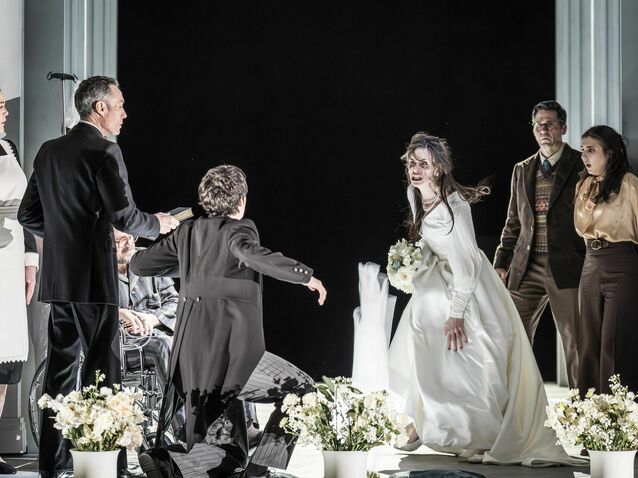
Jacquelyn Stucker as Ginevra in Ariodante ©2025 Marc Brenner
This is Dutch director Jetske Mijnssen’s debut with the Royal Ballet and Opera, and, setting the work in the modern day, she places the emphasis on the family unit. The King is shown as an ailing man, who feels a particular need for Ginevra to marry Ariodante, believing that this is necessary in order to ensure strong leadership. Dalinda becomes Ginevra’s sister as a way of making the protagonists even more of a close knit group, and enhancing such issues as sibling rivalry and jealousy. Mijnssen imagines the family members leading privileged existences, with the fact that their first reaction to heartache is to contemplate killing themselves revealing just how unused they are to enduring life’s trials and tribulations.
The setting is the interior of a palace, courtesy of designer Étienne Pluss, whose bare, monochrome walls reveal a similar aesthetic to Vilhelm Hammershøi paintings. The Overture sees the main protagonists as children playing at weddings and fighting, thus highlighting their sheltered existence and setting up the dynamics we are to see play out between them as adults.
While Mijnssen’s aim to make the characters as three-dimensional as possible is a good one, the sheer extent to which the opera seems to become a family drama narrows its focus. This in turn restricts what can be said with the arias, and impacts on how they can be illustrated visually. Having Ginevra boss the servants around as they arrange flowers to reveal her own expectant character in ‘Vezzi, lusinghe, e brio’ seems quite weak given the aria’s potential scope, and all too often the actions, such as the King falling from his wheelchair, feel clichéd.

Emily D'Angelo as Ariodante and Christophe Dumaux as Polinesso in Ariodante ©2025 Marc Brenner
Act II is the most successful as by now the house has opened up to reveal different rooms, thus hinting at the layers of intrigue and the recesses of people’s minds. It is here that Ariodante’s iconic ‘Scherza, infida’ is sung, and Emily D'Angelo gives an outstanding performance, imbuing her mezzo-soprano with sensitivity and feeling in a manner that completely draws us in to the character’s mindset. In fact, the soloists are strong all round, with Jacquelyn Stucker’s soprano revealing a winning combination of vibrancy, subtlety and nuance as she plays Ginevra. Elena Villalón displays a highly pleasing soprano as Dalinda, and Christophe Dumaux offers excellent technique and an intriguing countertenor as Polinesso. Ed Lyon reveals a smooth tenor as Lurcanio, and Peter Kellner a warm bass as the King of Scotland, while Emyr Lloyd Jones stands out in the relatively small role of Odoardo.
Over the evening as a whole, however, the cracks in the concept show. It is one thing to place the emphasis on the characters themselves, but the complete focus on the family dynamics excludes so many other things that the opera is as well, including a piece of entertainment. All of the ballets are cut, and while they would probably feel out of keeping with the overall presentation style, we lose a vital component of the work, as well as the opportunity to appreciate the influence of French dance music on the opera. The consequence is that, even allowing for the fact it is largely intentional, the performance feels too grey and austere. Similarly, while the ending has been altered to make a highly valid and commendable point, it still feels an unsatisfactory pay-off because it means we have spent a lengthy evening awaiting a resolution that never comes.
In spite of some difficulties with the staging, however, the evening comes highly recommended because of the strong musical credentials. These are epitomised by Stefano Montanari’s conducting as he delivers an extremely accomplished account of the score that reveals many subtleties and nuances. This is all while succeeding still in capturing a good overall pulse, and at times playing the violin himself, even as he directs the entire Orchestra of the Royal Opera House.
By Sam Smith
Ariodante | 9 December - 21 December 2025 | Royal Ballet and Opera, Covent Garden
the 11 of December, 2025 | Print






Comments