


 The Royal Opera ©2026 Mihaela bodlovic
Boris Godunov is Modest Mussorgsky’s only completed opera, and widely considered to be his masterpiece. Its subjects are the eponymous Russian ruler, who reigned as Tsar from 1598 to 1605, and the False Dmitry I, who succeeded him almost immediately but was killed a year later. The Russian language libretto was written by the composer, and is based on Pushkin’s blank verse drama Boris Godunov as well as Nikolay Karamzin’s History of the Russian State.
While, however, the opera’s story draws on historical fact, it is still best appreciated on its own terms because differences remain. When the son of Ivan the Terrible, Fyodor I, dies in 1598, Boris accepts the throne of Russia as Fyodor had no children. The reason why, however, there is no obvious successor is because Ivan’s far younger son Dmitry, who the Orthodox Church had never, in fact, acknowledged as legitimate anyway, died under mysterious circumstances in around 1591. Possibly in real life, but certainly in the opera, Godunov was responsible for his murder, and his sense of guilt takes hold so that over his seven year reign he descends into madness and dies a broken man. In real life, Boris spread rumours that the person claiming to be Dmitry, who many of his supporters even knew was an imposter, was a runaway monk named Grigory Otrepiev. Historians generally believe that he was, but in any case this is the truth in the opera.
There are two versions of the work, and one of the selling points of Richard Jones’s 2016 production for the Royal Opera, which is now enjoying its second revival, is that it presents the original 1869 version in its entirety. Many productions have purported to do so, but while Francesca Zambello’s English National Opera production of 1998 essentially presented the earlier piece, it inserted the closing scene from the 1872 version, while a Proms performance from Opera North in 1992 could not resist giving John Tomlinson the monologue from the later version to sing in the scene in the Tsar’s Terem.
The joy of experiencing the 1869 version lies in the fact that it enables us to witness those elements of Mussorgsky’s creation that are missing from the later incarnation. For example, the people being shown as indifferent to the will of the authorities at the end of Scene I was cut to avoid offending the censor, but the episode’s inclusion is useful in revealing much about the Russian character. Similarly, the chronicler-monk Pimen’s intimate description of the murder of Tsarevich Dmitry was removed, presumably because it was felt to be too exposing of the regime, but it contributes much to the drama and chill of the narrative.
Although the changes were largely forced upon Mussorgsky, he was in some ways happy to produce a second version because he relished the opportunity to achieve a new generosity of line in Boris’s vocal part. Nevertheless, although it is true that his monologues in the earlier version feel somewhat drier, they are worth experiencing for the development of several brooding orchestral themes, with the ‘leitmotifs’ clarifying the strands of the Tsar’s political thought, personal reflection and private torment.
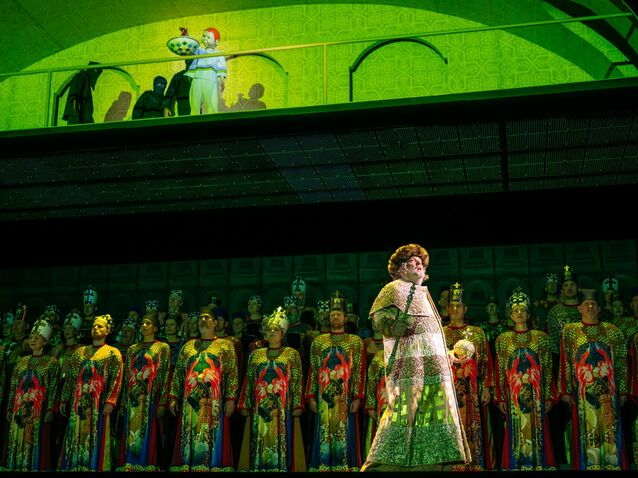
Bryn Terfel as Boris Godunov in Boris Godunov, The Royal Opera ©2026 Mihaela Bodlovic
Jones’s production, which is revived on this occasion by Ben Mills, runs without an interval, with the stage dominated throughout by the same box-like set designed by Miriam Buether. Although it feels minimalist overall, there are a wealth of details to be found within it, and the walls are covered with a bell motif that emphasises their prominence in the score, the opera and Russian life more generally. There is also a touch of the Brecthian about the staging as when Grigory flees the inn close to the Lithuanian border the other characters react by pushing the long bar off the stage, thereby executing the necessary scene change.
The set creates a spacious and uncluttered area that enables the chorus, which often sounds brilliantly overwhelming, to confront us en masse, and individual characters to dominate while sometimes coming across as lost souls. It can, however, encourage a degree of stylisation that does not make the crowd in Scene I feel as much of a rabble as would be ideal, or see the coronation scene become quite as powerful as it might since everyone stands in rather too ‘regimented’ a way.
A second storey embedded in the back wall stands above the main stage. Different activities occur on it with the murder of Tsarevich Dmitry by three assassins being ‘replayed’ at intervals. We also see the policemen searching for Grigory gathering there before entering the inn, and disloyal Boyars swearing their allegiance to the false Dmitry, overseen by Prince Shuisky. The two storeys can thus highlight different ‘realities’, whether this be the realms of the elite above and the masses below, or through the playing out of Boris’s past deeds and present nightmares in the upper space.
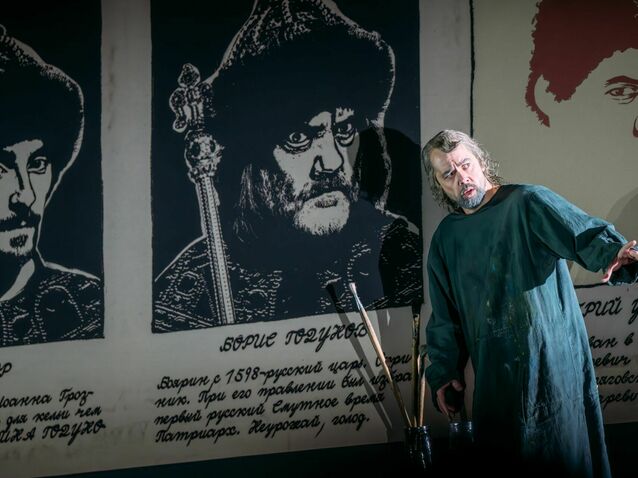
Adam Palka as Pimen in Boris Godunov, The Royal Opera ©2026 Mihaela Bodlovic
The production’s attempt to speak to us by universalising the opera’s themes sometimes impedes our ability to believe in the reality of the specific scenario we see unfold. The fact that Nicky Gillibrand’s costumes appear to cover quite a wide period also brings home Jones’s point that what we see is what happened to Tsars more generally, so that the opera becomes a wider commentary on a ‘dog eats dog’ world. In this respect, the staging’s final image is not so much presenting a new twist to the ending of this particular story as, by drawing attention to what actually happened to Boris’s son, emphasising the cyclical nature of the events we have just witnessed.
If certain issues prevent this from being a vintage staging, it still has plenty of merit, with the bold overarching concept being complemented by a plethora of thoughtful touches. For example, Pimen’s chronicle is here represented visually with four giant pages of it standing upright, each one describing a different Tsar. The penultimate page reveals Boris and the final one bears an unfinished picture of the dead Tsarevich Dmitry, which looks very much like Grigory. This helps to add weight to the idea that when Pimen invites Grigory to write the rest of the story, the latter interprets this as meaning something other than merely chronicling the events that unfold.
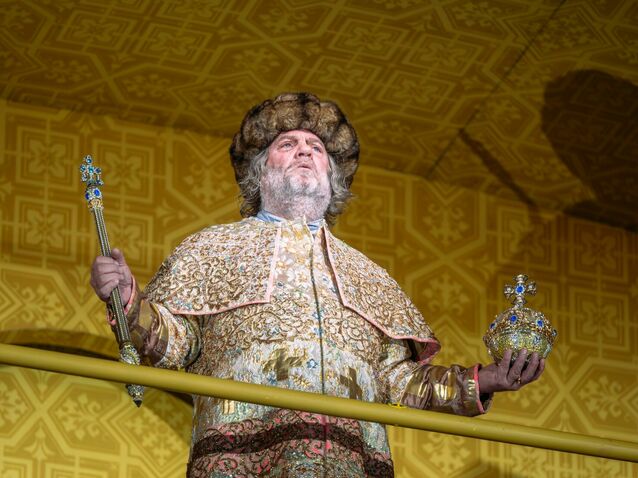
Bryn Terfel as Boris Godunov in Boris Godunov, The Royal Opera ©2026 Mihaela Bodlovic
When an undoubtedly decent staging combines with a first rate set of performances, the results demand to be seen. The opera includes a large number of soloists, and in this instance many of them fit their roles so well, judged by both their voices and acting, that it becomes almost impossible to imagine anyone else in them. Sir Bryn Terfel, who also played the title character in this production in 2016 and 2019, is a captivating Boris Godunov who asserts his bass-baritone to excellent effect, and convincingly captures the way in which the Tsar’s guilt becomes so all consuming that he is driven to madness and death. Adam Palka uses his strong and secure bass to present the chronicler-monk Pimen as a ‘mystical academic’ who cannot be but disturbed by the murder and machinations of which he is all too aware.
Andrei Kymach’s baritone rings out in such a way as to make it hard to picture him being bettered as Shchelkalov, Clerk of the Boyars’ Council, while John Daszak uses his striking tenor to capture the essence of the scheming Prince Shuisky to perfection. Alexander Roslavets utilises his robust bass to make Varlaam highly entertaining, while as the Holy Fool Mingjie Lei’s tenor possesses a sorrow that makes us take notice just as much as the Tsar. There are also superb performances from Jamez McCorkle as Grigory Otrepiev and Hannah Edmunds as Ksenia, while Robert Berry-Roe, who shares the role across the run with Zechariah King, is an exceptionally accomplished Fyodor. In the pit, Mark Wigglesworth delivers a technically and musically tight account of the score, which in itself ensures that the music is overwhelmingly powerful when it needs to be.
By Sam Smith
Boris Godunov | 29 January - 18 February 2026 | Royal Ballet and Opera, Covent Garden
the 02 of February, 2026 | Print

Comments