


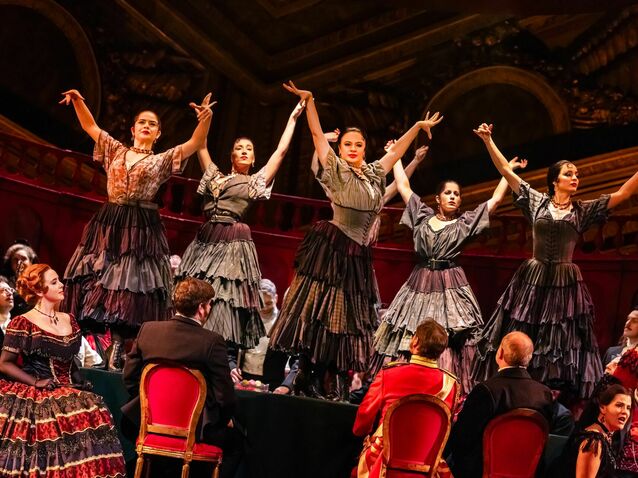
 La traviata, The Royal Opera © 2026 Pamela Raith
Giuseppe Verdi’s La traviata of 1853, with a libretto by Francesco Maria Piave, is one of the most frequently performed operas in the world today. Based on Alexandre Dumas fils’s play La Dame aux camélias, it tells of Violetta Valéry who is a famed Parisian courtesan. Beneath her apparently carefree exterior, however, she is suffering from tuberculosis and her world is shaken when she meets Alfredo with whom she falls in love. They run away together and live off the sale of her goods, but one day Alfredo’s father Giorgio Germont appears and begs her to leave his son. This is because Alfredo’s behaviour has brought disgrace on his family, which is impacting on the ability of Germont’s daughter to marry and be happy. Despite loving Alfredo deeply, Violetta shows compassion towards the family and agrees.
Alfredo, however, does not discover the real reason why Violetta has suddenly walked away, and everything comes to a head when he angrily confronts her at Violetta’s friend Flora’s party. He eventually discovers the truth as his father also regrets pushing them apart, but by this time Violetta is terribly ill and, though the pair are finally reconciled, she dies in his arms.
There is much debate over how autobiographical Verdi’s creation is because he was himself judged by society for living with the soprano, Giuseppina Strepponi, out of wedlock from the late 1840s (they were married in 1859). However, when the chorus suddenly condemns Alfredo for his treatment of Violetta at Flora’s party it is certainly tempting to see this as the composer’s way of getting the people to take his own side.
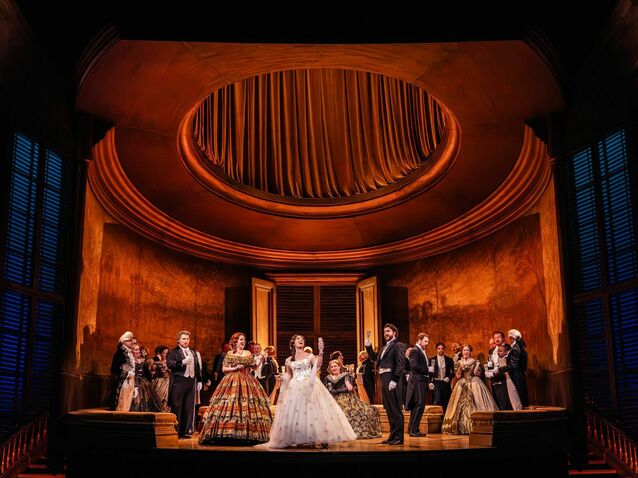
Ermonela Jaho as Violetta Valéry in La traviata, The Royal Opera ©2026
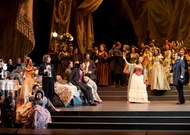
Richard Eyre’s production for the Royal Opera, revived on this occasion by Simon Iorio, began life in 1994, and many subtle touches are to be found within its curved walls. Designer Bob Crowley works virtually every scene around a semi-circular set, with each one employing its own tools and techniques to shed light, and provide commentary, on the action.
Act I takes place in a sumptuous ‘Art Deco’ interior, revealing Violetta’s role as the archetypal fashionable Parisian. The most important features, however, are the doors. Whenever these are open, and people are free to enter, Violetta assumes her outgoing, sociable persona. As soon as they close, on the other hand, she becomes a far more introverted character. Indeed, the end of the Overture sees her sitting to one side in great discomfort, and it is only when the doors open at the start of the Act that she musters the strength to rise and host her party. They swing out once more as she moves from the contemplative ‘Ah fors’è lui’ to the carefree ‘Sempre libera degg’io’, in which she reasserts her wish to enjoy Parisian life to the full.
Similarly, Act II’s gambling scene takes place beneath an ornate palace roof, its gilded surfaces lying at peculiar angles. Here we find a red bullring and a casino table with overhanging metal light. It is not to be taken as a literal space, but clearly the bullring alludes to the antics of Gastone and his friends as matadors, and creates an appropriate arena for action that all too readily alludes to gladiatorial combat. At the same time, the insertion of the more modern table and lamp under the palace roof may suggest that this form of gambling takes its place within a far greater history of wealth and decadence in Paris.
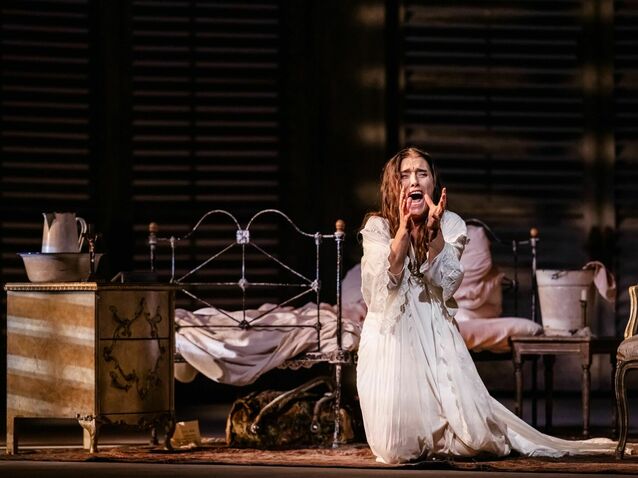
Ermonela Jaho as Violetta Valéry in La traviata, The Royal Opera ©2026 Pamela Raith
The strength of the production, however, can be somewhat taken for granted, meaning that our judgment tends to be dictated by the specific performances we see on the night. Over the current run, each of the main principal parts is to be shared between three different singers, and all will undoubtedly bring their own unique qualities to the roles. On opening night Ermonela Jaho proved to be a deeply sensitive and affecting Violetta, with the frequent placing of her hand on her face or neck in Act I acting as a sign of her ‘social butterfly’ status, her nervousness at thoughts of Alfredo, or her ill health, depending on the context.
Jaho’s performance is characterised by vocal subtlety as in ‘Ah fors’è lui’ her relatively quiet, and sometimes virtually hushed, sound cuts through the air with remarkable clarity. In the process, she draws us into Violetta’s mindset completely, and the sheer precision and nuances to be found in her soprano are quite mesmerising. In line with this, her subsequent performance of ‘Sempre libera degg’io’ is not quite as full blooded as in many portrayals, but while many Violettas ‘snap’ from one mood to the other to put distance between the two attitudes being expressed, Jaho maintains more continuity by revealing just how completely she is weighed down by thoughts of Alfredo throughout the second aria. Her performance of ‘Addio, del passato bei sogni ridenti’ is heartbreakingly tender, and it all adds up to a very emotional assumption of the role.
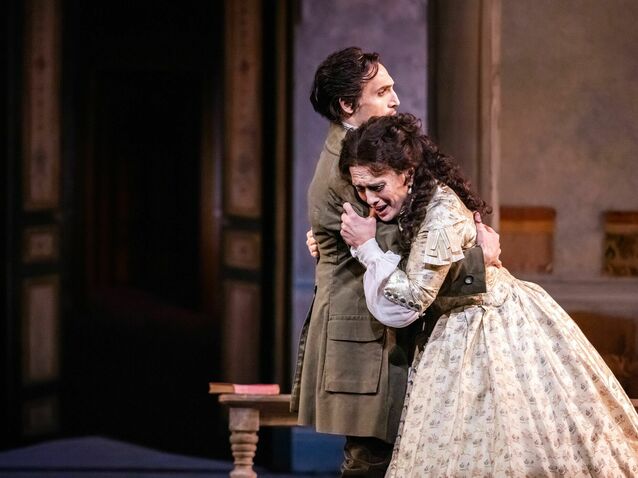
Giovanni Sala Alfredo Germont Ermonela Jaho as Violetta Valéry in La traviata, The Royal Opera ©2026 Pamela Raith
If Jaho provides the standout performance, all three main principals are strong in their own right. Giovanni Sala, with his highly pleasing tenor, makes an excellent Royal Opera debut as Alfredo. He creates a highly believable character as he shows how his well intentioned devotion increasingly vies with his self-righteous sense of victimhood. If there is a difficulty it is that the various approaches to the individual parts do not always make for the strongest interactions. Aleksei Isaev asserts his tremendous baritone to brilliant effect as Giorgio Germont, but it feels quite a mismatch for Jaho’s more subtle soprano so that the characters seem to exist on somewhat different planes. Of course, it makes sense that in Act II’s first scene Germont would be expectant and overbearing while Violetta would feel fragile and vulnerable, but there still needs to be real chemistry between the pair. In this instance, such contrasting sounds do not aid the empathy that needs to be conveyed as Germont increasingly appreciates the huge sacrifice he is asking of Violetta.
There is splendid support from Veena Akama-Makia as Annina, Barnaby Rea as Doctor Grenvil, Ellen Pearson as Flora Bervoix, Sam Hird as the Baron Douphol, Giorgi Guliashvili as Gastone de Letorières and Ossian Huskinson as the Marchese d’Obigny. The conducting of Antonello Manacorda, who shares duties over the run with Giacomo Sagripanti, is meticulously paced. With this enabling lines to be delineated extremely well, so that the nuances in each come across very clearly, his approach perfectly complements Jaho’s own.
The other performers across the run include Pretty Yende and Rachel Willis-Sørensen (Violetta), Bekhzod Davronov and Charles Castronovo (Alfredo) and Amartuvshin Enkhbat and Christoph Pohl (Germont). This production, featuring the cast and conductor described above, will be broadcast live to selected cinemas around the world on 14 January, with some venues also showing encore screenings on subsequent days. Given that many of the characterisations are so detailed and subtle, the performance should work very well in close up.
By Sam Smith
La traviata | 8 January - 17 February 2026 | Royal Ballet and Opera, Covent Garden
the 10 of January, 2026 | Print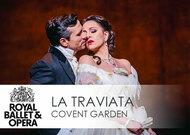


Comments