


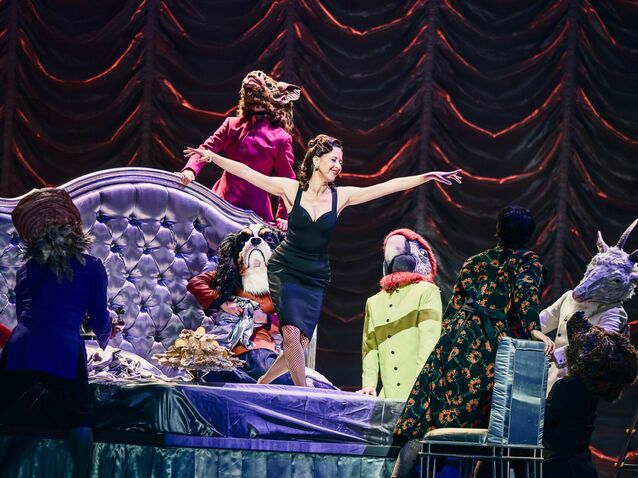
 © Ian Hippolyte / Royal Ballet and Opera
The story to be found in George Frideric Handel’s Alcina, which first appeared at the Theatre Royal, Covent Garden in 1735, comes from Ludovico Ariosto’s epic sixteenth century poem Orlando furioso. It was employed for many operas, one of which was Riccardo Broschi’s L'isola di Alcina, which premiered in Rome in 1728. Handel acquired Antonio Fanzaglia’s libretto for it the following year during his travels in Italy, and that for his own opera was arranged by Antonio Marchi based on Fanzaglia’s text.
The plot sees the heroic knight Ruggiero trapped on an island by the sorceress Alcina, who has used her supernatural powers to make him love her and forget all about his fiancée Bradamante. Alcina’s isle is, in fact, a desolate place, but through magic she has made it appear green and lush. By doing so, she has seduced every knight who has come to it, and then turned each into a stone, animal or plant once she has lost interest.
When Bradamante, disguised as her own brother Ricciardo, and Ruggiero’s former tutor Atlante, under the guise of the sailor Melisso, journey to the island to find Ruggiero, all manner of misunderstandings arise. Alcina’s sorceress sister Morgana, really believing ‘Ricciardo’ to be a man, falls in love with him, much to the consternation of her own lover Oronte who challenges him to a duel. Meanwhile a boy named Oberto searches the isle for his missing father Astolfo, who he does not know has been transformed by Alcina. When Bradamante finds Ruggiero, he does not even recognise her but over time, with the help of Atlante, he realises the truth and attempts to escape from Alcina’s clutches. At this point, it becomes clear that Alcina really does love Ruggiero. With her feelings for once being genuine she no longer has any recourse to deceit or artifice, which leads her to lose her powers and finally to the release of all of the knights, including Astolfo, from their enchantment.
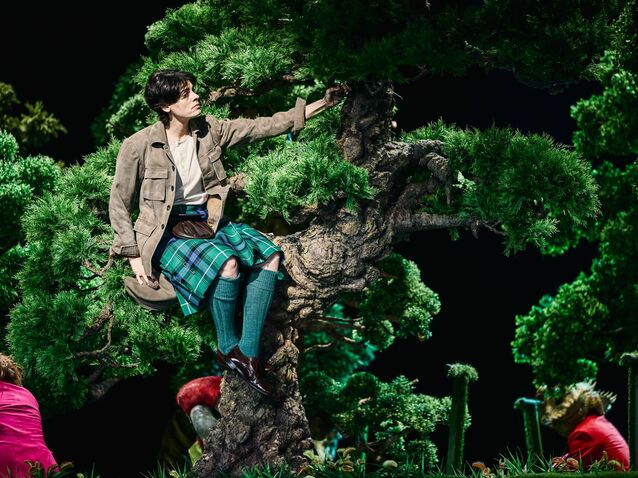
Emily D'Angelo as Ruggiero in Alcina, The Royal Opera © 2026 Ian Hippolyte
When Richard Jones’s staging, which represents a co-production with New York’s Metropolitan Opera, first appeared at the Royal Opera House in 2022, it was generally well received. It tended, however, to be viewed as a staging that, despite strongly juxtaposing illusion and reality, was predominantly designed to be fun. On this occasion, when it is revived by the original movement director Sarah Fahie, it feels easier to appreciate the production’s hidden depths, as it becomes very clear how the supposedly ‘straight and narrow’ road can be sinister in its own right.
The contrast between the real but dull, and glamorous yet artificial, is obvious from the start. The Prelude sees a group of performers dressed in simple black, white and blue colours gather around ready to sing. Their scores, like the stage curtain, sport a logo proclaiming “The Only Path: Love, Duty, Courtesy, Mercy”, which reflects what Atlante once taught Ruggiero. Then Alcina appears, freezes them and removes their music. This reveals her transforming of the knights, and her luring of Ruggiero to the island.
In order to aid the dynamism, the enchanted knights do not represent a combination of animate and inanimate objects. Instead, all become animals such as dogs, parrots, goats and hares, with beautifully crafted masks topping otherwise human clothes. The opera contains several musical sequences that were originally composed for the dancer and choreographer Marie Sallé, and by keeping the animals upright on two legs it gives them the opportunity to engage in much entertaining dancing, such as during Morgana’s aria ‘Tornami a vagheggiar’. The animals also act as servants to Alcina, which is an interesting touch because, while this could be seen as resulting from their enchantment, it also suggests a degree of complicity on their part.
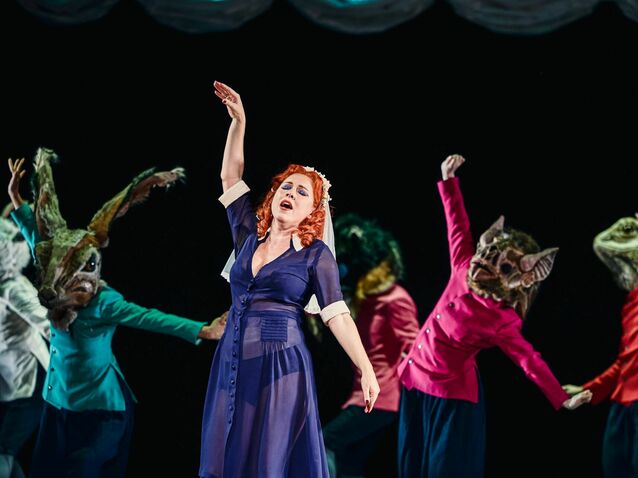
Mary Bevan as Morgana in Alcina, The Royal Opera © 2026 Ian Hippolyte
The urn, which is the source of Alcina’s magic, becomes a huge bottle of perfume that the sorceress sprays people with in order to enslave them. When Atlante enables Ruggiero to see that the island is pure artifice, we are also shown how everything is an illusion by having the spectacle reduced to just this bottle and a few animal masks. In fact, in Antony McDonald’s set, the audience is given multiple perspectives on the scenario throughout by having the ‘green meadows’ of which Ruggiero sings wheeled on and off periodically, so that it experiences both the illusion and the stark reality of a bare stage when these are absent.
The costumes of Atlante and the other figures at the start feel quite Puritanical, and, while their supposedly steadfast values seem to stand in direct contrast to Alcina’s hedonistic ways, the production suggests they are distasteful in their own right. It is the claim that their approach is “The Only Path” that makes it feel so stifling, and when we see the enchanted knights, still with their animal heads but now dressed ‘Puritanically’, pursing Alcina en masse while brandishing tools as weapons, the philosophy feels highly threatening.
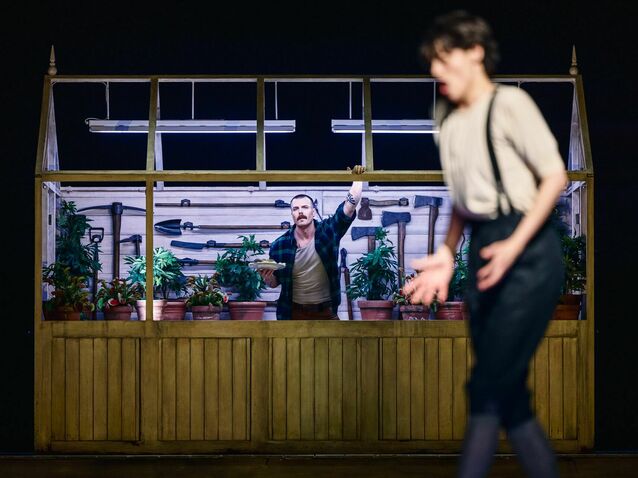
Ru Charlesworth as Oronte in Alcina, The Royal Opera © 2026 Ian Hippolyte
Oronte (a superb Ru Charlesworth) is made a particularly interesting character in this production, as he takes a middle way between Alcina’s and the ‘Puritanical’ stance. He warns against artifice in ‘Semplicetto! A donna credi?’ but also rejects “The Only Path” book when Atlante offers it to him. His potting shed possesses prosaic tools alongside the lush greenery, which suggests that he has to think about the mechanics of creating illusions. He carries out unsavoury actions such as killing a mouse, but then feeds it to a rather exotic Venus flytrap. One cannot help but think of Grant Wood’s iconic painting American Gothic as Oronte brandishes a pickaxe (rather than a pitchfork), and the shed’s wooden panelling feels like that of the farmhouse in the picture.
After seeing the normal downfall of Alcina, the ending here also sees the defeat of the opposing hard line stance, and in the process it overcomes one difficulty with the original opera. It was standard in Handel’s operas for all of the principals to participate in the final chorus, even those who had no cause to share in the general rejoicing, but this staging explains why Alcina would be singing triumphantly alongside everyone else.
Four of the principals reprise their roles from 2022 including Lisette Oropesa who is just as stunning in the title role now as before. Her glistening soprano combines with superlative stage presence to suggest someone who is as alluring as she is also vulnerable. Several glamorous pictures of her appear on a wall, and one of them conveys her character perfectly by suggesting all of the innocence or otherwise of Holly Golightly from the famous poster for Breakfast at Tiffany’s. Emily D'Angelo, with her dark and nuanced mezzo-soprano, gives a captivating performance as Ruggiero, Beth Taylor offers a wonderfully emotional interpretation of Bradamante, while, as Morgana, Mary Bevan’s relatively soft soprano is highly engaging. There is also outstanding support from Edward Grint as Atlante and treble Thomas Mayes, who shares the role of the child Oberto over the run with Kieran Lund-Deely. David Bates’s conducting of the Orchestra of the Royal Opera House is excellent, with the pulse he achieves during Alcina’s ‘Ah! mio cor, schernito sei’ combining a certain urgency with seemingly infinite sensuousness.
By Sam Smith
Alcina | 15 September - 3 October 2026 | Royal Ballet and Opera, Covent Garden
the 17 of September, 2026 | Print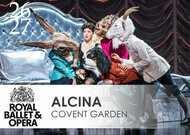





Comments