


 © Camilla Greenwell
Turandot, with a libretto by Giuseppe Adami and Renato Simoni, is Giacomo Puccini’s final opera. It was left unfinished at the time of his death in 1924, and posthumously completed by Franco Alfano before premiering at Milan’s Teatro alla Scala in 1926. There have subsequently been other completions of the score, most notably by Luciano Berio in 2001, but the Alfano version remains the most frequently performed, and is the one used in this instance.
Set in Peking in legendary times, it sees Calàf, son of the deposed King of Tartary Timur, fall in love with Princess Turandot, daughter of the Emperor Altoum. He becomes infatuated the moment he sees her, but the only way to win her hand is to answer three riddles correctly, with the penalty for failure being death. Many have tried and not one has survived, leading Timur, his slave girl Liù, and the Emperor’s Ministers Ping, Pang and Pong to attempt to dissuade him from pursuing her. Calàf ignores them all and faces Turandot, who explains that she set this challenge to avenge the murder of Princess Lo-u-ling, who now shelters in her spirit, by a man a thousand years ago. Calàf answers all three riddles correctly, but she protests against being given like a slave. While the Emperor asserts that the rules are sacrosanct, Calàf, not wishing to possess Turandot against her will, sets her a new challenge that if she can discover his real name before dawn he will die.
Turandot directs all resources towards seeking out his name, insisting it must be revealed under pain of death. It becomes clear that Liù alone knows it, prompting Turandot to torture her and threaten worse in order to extract it. Liù remains steadfast, but, fearing how much she can withstand, stabs herself to ensure she never gives away the secret. Calàf orders Turandot to come down to earth, while she continues to insist she is the daughter of heaven, but when he kisses her she is transformed. Turandot declares she has been defeated, not by the trial but by the fever that now flows from him to her. The opera ends with her proclaiming Calàf’s newly discovered name, which she now knows to be Love, to the crowds.
Turandot, The Royal Opera ©2025 Camilla Greenwell
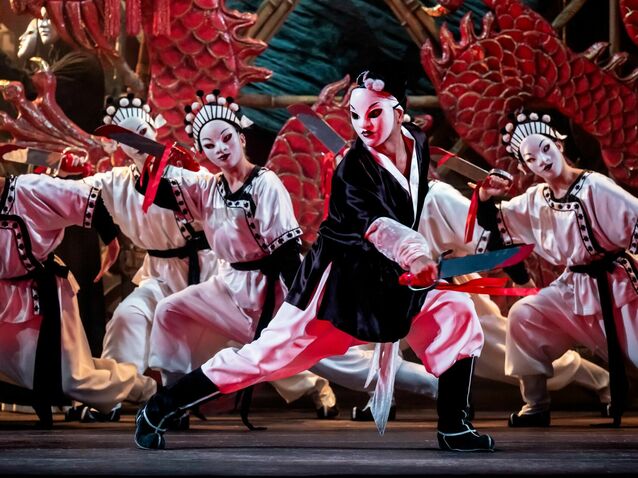
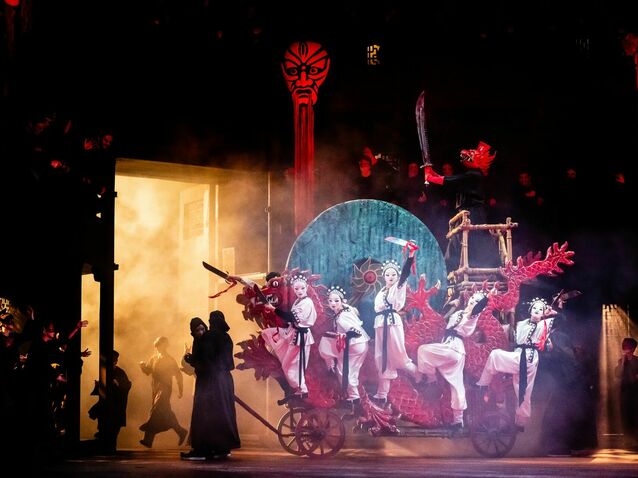
Andrei Șerban’s production, which is revived on this occasion by Jack Furness, premiered in 1984, but even at the age of forty-one it feels as fresh as ever. The secret to the staging’s success is that, on the surface, it appears to be quite traditional as bright costumes, masks, wooden structures and Chinese dancing (courtesy of choreographer Kate Flatt) dominate. It proves to be multifaceted, however, by clearly highlighting the full range of horrors that lie beneath the colourful veneer. Turandot is an unsympathetic character who uses a thousand year old wrong to justify death to numerous people who were never responsible for the original evil. Although we might accept this as part of a set-up that enables her then to undergo a personal transformation, the opera does present a story, and by extension world, in which there is far more cruelty than beauty. Șerban’s staging reflects this by seeing dancers, who are ostensibly there to entertain, mime the slitting of their throats as a way of premeditating Calàf’s likely fate. Similarly, the fact that Ping, Pang and Pong (Simone Del Savio, Emmanuel Fonoti-Fuimaono and James Kryshak on top form) beat Liù with stylised, slow motion gestures means that an incredibly violent act is veiled by being presented in a theatrical manner. When so many opera productions today go all out to reveal just how distasteful the story that is being told is, Șerban hides the reality behind a cloak of ‘respectability’ that, if anything, makes it even more hard hitting.
The production is full of telling details. Calàf takes Timur’s staff to strike the gong that signals his acceptance of the challenge, signifying how his decision is removing his father’s means of escaping the situation. Four huge masks on poles overlook the stage, which at first appear decorative or ritualistic as red ribbons stream from their eyes, mouths and necks. When the Phantoms of those who died undertaking the challenge sing, however, we realise these are their severed heads, and the ribbons blood. Masks carry significance in other ways, as revealed by the Prince of Persia wearing one as he is led to his death. Does it merely hide the tears and fear that lie behind it, or in its own right describe the passivity of one who is resigned to his fate?
The huge wooden structure that makes up Sally Jacobs’ set, with its latticed windows through which light courtesy of F. Mitchell Dana floods, may typify traditional Chinese architecture. Its greater significance, however, lies in the way in which it creates an arena for the action that reveals the entirely repressive nature of the situation. The principals’ costumes may be brightly coloured, but the chorus who occupy the surrounding tiers as spectators are dressed in grey and brown. Theatrically this contrast leads our eye towards the action in the centre, but it says an enormous amount about the rights and status of the ordinary city dwellers. Even when there is much spectacle to become lost in, it cannot mask the fact that this is a very hierarchical society in which ministers, mandarins, guards, entertainers and executioners all have and know their place.
Anna Netrebko as Princess Turandot and Yusif Eyvazov as Calaf in Turandot, The Royal Ballet and Opera © 2025 Camilla Greenwell
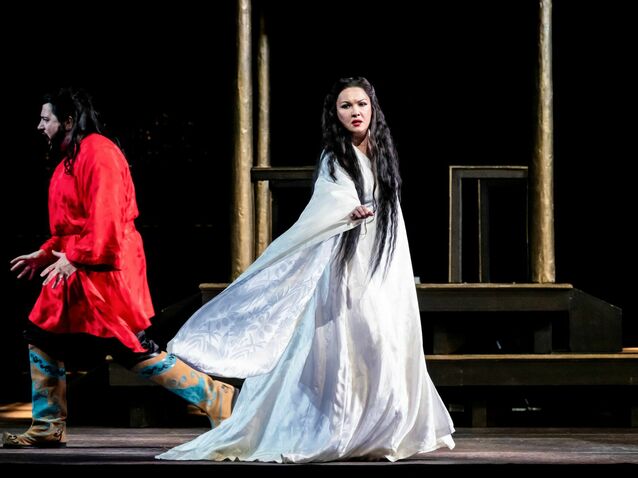
This revival is as strong as ever, with Anna Netrebko as Turandot and Yusif Eyvazov as Calàf proving to be something special. Netrebko is possessed of a dark and rich soprano, and yet at the top of her register there is still a great cleanness that makes for an ethereal sound. Eyvazov reveals a notably expansive and impassioned tenor that makes his performance of ‘Nessun dorma’ an undoubted highlight of the evening, but it is the interaction between the pair that really tops things off. During Act II Netrebko appears magisterial and proud as her arm movements see her typically stretch one out and put the other across her body, and, while the actions may be attributable to the original choreography, the sheer extent to which Netrebko makes them speak about Turandot’s character is remarkable. She knows that Calàf will be intimidated by her presence, and Eyvazov shows how he is, even as he finds the courage to fight on. When it comes to the third riddle, when Turandot is increasingly rattled, she removes her mask and gazes down at him as if she is now aiming to seduce him into faltering. Then when he solves it, it feels as if the death that it seemed so certain would be his is suddenly hers as she collapses in despair. Once Calàf has set the new challenge, however, she regains her composure and departs as arrogantly as ever.
If Netrebko and Eyvazov are superb at generating atmosphere with their performances, so too are the other principals. In particular, the manner in which Ping, Pang and Pong enter following the stirring ‘Nessun dorma’ instantly brings Calàf and the audience back down to earth to face up to the harsh realities of the situation. Masabane Cecilia Rangwanasha gives a superlative performance as Liù as her soprano is so secure that it can express resolve but also fragility and vulnerability, making the scene in which she takes her life exceptionally poignant. There is also excellent support from Rafał Siwek as Timur, Raúl Giménez as the Emperor Altoum and Ossian Huskinson as the Mandarin. In the pit, Daniel Oren brings out the sheer monumentality of Puccini’s score with quite thrilling results.
Amidst the final rejoicing Timur leads the chariot carrying the body of Liù across the stage. As we see the expression on Siwek’s face we know that Timur’s love for Liù is not the same as Calàf’s for Turandot or Liù’s for Calàf, for which no price is too high to pay. Rather it is the deep affection that a master would have for a servant who had been so loyal, and consequently feels extremely human. The introduction of this ‘funeral procession’ does not completely undermine the opera’s ending, but it is enough to leave a bad taste in the mouth as it is noticeable that the body passing by reveals more movement than anything else occurring on stage at that moment.
Many roles are shared between two or more performers across the run. Maida Hundeling and Anna Pirozzi are the other singers to assume the title role, Arsen Soghomonyan and Roberto Alagna also play Calàf, and Juliana Grigoryan and Vitalij Kowaljow take on the parts of Liù and Timur respectively for certain performances.
By Sam Smith
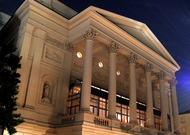
Turandot | 15 December 2025 - 30 January 2026 | Royal Ballet and Opera, Covent Garden
the 17 of December, 2025 | Print

Comments