


 © Mihaela Bodlovic
The Turn of the Screw is a 1954 chamber opera by Benjamin Britten, with Myfanwy Piper’s libretto being based on Henry James’s eponymous novella of 1898. Told across a Prologue and sixteen scenes, with each of these being preceded by a variation on the twelve-note ‘Screw’ theme, it has been described as one of the most dramatically appealing of all English operas.
Set in an English country house in Bly, originally in the middle of the nineteenth century, it tells of a young Governess who is employed there to care for two children by their uncle and guardian. He, being busy in London, has instructed her never to write to him about the youngsters, never to inquire about the history of Bly House and never to abandon the children.
As the Governess, who is never named, meets the young Miles and Flora, and housekeeper Mrs Grose, all seems fine. However, a letter soon arrives informing the Governess that Miles has been expelled from school, which she ignores believing him to be too innocent to have done anything that might warrant expulsion. Meanwhile, she spies a pale faced man standing on a tower of the house and then staring through a window. Mrs Grose explains that Peter Quint, the former valet at Bly House, had sexual relations with the former governess Miss Jessel, and both seemed to have inappropriately close relationships with the children before they died. What follows becomes a very personal battle between the Governess and the ghosts of Quint and Miss Jessel (who are both seen with increasing regularity) for the very souls of the children, with the outcomes for each of the youngsters being quite different.
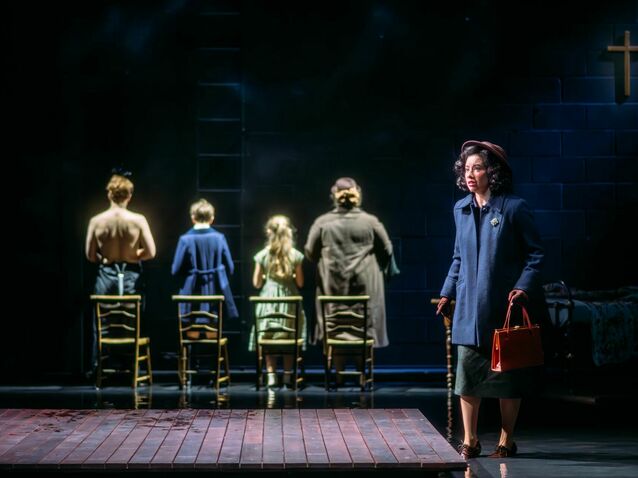
Isabelle Peters as Governess in The Turn of the Screw ©2026 Mihaela Bodlovic
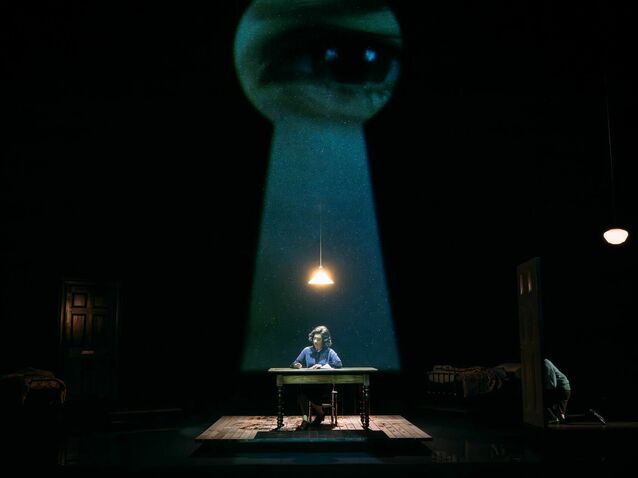
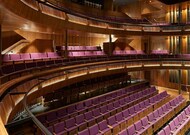
Although the work is frequently seen on large stages such as that of the London Coliseum, the fact it is a chamber opera means it fits the parameters of the Royal Opera House’s smaller Linbury Theatre well. Director Natalie Abrahami and set designer Michael Levine exploit the space to create a particularly dark and atmospheric production of the work, even by the measure of what the opera naturally invites. The Prologue is delivered in complete darkness, while the Governess sings The Journey, which constitutes Scene I, with nothing more than her face illuminated.
Bly House is represented not with sturdy walls, but with freestanding doors and windows, and beds and desks that are pushed into place as the drama demands. A transparent front cloth hangs over the stage onto which are projected live pictures of the characters staring through the window, courtesy of video designer Duncan McLean, and images of eyes looking through keyholes and fingers running across piano keys. Lighting designer Guy Hoare ensures that everything feels hauntingly dark, so that we positively feel how the forces of evil are taking hold with there being no chance of escape.
When Flora and the Governess are at The Lake in Act I’s Scene VII, the stage becomes covered with water, which remains for the rest of the opera. This reveals how, as Quint and Miss Jessel put it, ‘The ceremony of innocence is drowned’, and with it flooding the house as much as the grounds, characters often look as if they are desperately perched on rafts, fearing for their very survival.
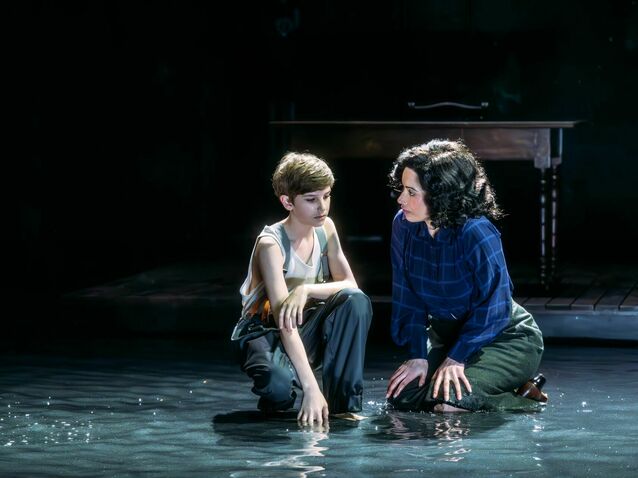
Phoenix Matthews as Miles and Isabelle Peters as Governess in The Turn of the Screw ©2026 Mihaela Bodlovic
Although the approach is highly effective, it could still be criticised for making the drama too heavy and unrelenting. In the same way as chiaroscuro requires light as well as dark, so too does this opera so that we are periodically led to believe that everything is in the Governess’s mind and that objectively there is no problem. In this respect, the starts of The Lesson in Act I and The Bells in Act II should offer moments of relief, as the acts of teaching the children and heading to church feel completely normal, but they largely fail to do so here. In both scenes, the situation soon becomes strange anyway, but without points when we can convince ourselves that all is right with the world, there is insufficient contrast to keep the emotional colour wheel turning.
Similarly, having the parts of Peter Quint and Miss Jessel doubled by silent actors may make the evil feel all embracing, but, by showing how it is everywhere, it undermines the notion of one specific person having a hold over another. Nevertheless, the additions do serve some purposes, and not only by enabling momentum to be maintained by seeing the extra ghosts contribute to some very slick scene changes. They play out many subtexts so that when Quint and Miss Jessel meet at the start of Act II, she can bemoan him for calling her, even as her simultaneous interaction with the silent Quint suggests she is not as unwilling a partner as she suggests. Act II’s Scene VI is one moment when we really do feel the Governess and Mrs Grose’s attempts to make everything seem normal as Miles plays the piano, with the fact that the staging shows it is anything but highlighting the gulf between the wish and reality. The overall impression offered by the production is one of total disintegration of the house, and thus order, so that by the end we can hardly believe that we saw it stand as firmly as it did not long so ago.
Isabelle Peters is a suitably concerned, and increasingly distraught, Governess who displays a highly sensitive soprano. Claire Barnett-Jones, with her strong and engaging mezzo-soprano, is an extremely believable Mrs Grose, while Elgan Llŷr Thomas and Kate Royal are luxury casting as the ghosts Quint and Miss Jessel. The children are beautifully sung by Phoenix Matthews and Glenn Tong (who share the role of Miles across the run) and Emilia Blossom Ostroumoff and Fleur Mauxion (both Flora), while Peter Willoughby and Clare Kate O'Brien play their parts to the full as the silent ghosts who here are named Peter and Cathy. Bassem Akiki’s conducting of the thirteen strong Orchestra of the Royal Opera House is masterly, and also contributes substantially to the intensity of the evening.
By Sam Smith
the 31 of March, 2026 | Print






Comments