


 © De Materie
General informations
- Composer:Louis Andriessen
- Librettist:Louis Andriessen
- Creation date:01/06/1989
- Creation place:Netherlands
- Acts number:4
- Opera House of original production:Dutch National Opera.
Work description
In the early 1980s, the Dutch National Opera and the Holland Festival commissioned a new work from Louis Andriessen, arguably one of the most notable Dutch composers of the era. Between 1984 and 1988, he set about composing a deeply original opera that defies easy categorization: De Materie (Matter), structured around the notion of “matter” as a “philosophical, Marxist, artistic, and scientific concept.”
Far removed from the conventions of traditional opera, De Materie features no tragic heroes, relies on no dramatic libretto, and employs neither classical orchestration nor a standard chorus. Comprising four distinct “movements” (each transporting the spectator to a specific setting centered on a different approach to matter), the work draws inspiration from history and its major figures, setting them to music to explore the relationship between the immaterial and the material, as well as the roles of spirituality and science. Across these four movements, the music unfolds as a blend of the highly contemporary, repetitive and hypnotic, and influences ranging from Bach and Igor Stravinsky to disco and boogie-woogie. According to the composer, the work takes on the character of an “ultra-theatrical symphony” or an “opera of ideas.”
De Materie premiered on June 1, 1989, at the Muziektheater in Amsterdam in a landmark production directed by Robert Wilson – a staging that was “abstract, absurd, and colorful, interspersed with choreographed interludes”. The director had collaborated closely with Louis Andriessen during the work's composition. Wilson’s production was subsequently performed in cities including London, Turin, New York, Washington, or Los Angeles. De Materie was subsequently revived in August 2014 in a new production by Heiner Goebbels described as both “imaginative and large-scale”, that featured zeppelins and characters in period costumes. In September 2026, Opera Ballet Vlaanderen is reviving the opera in a new production entrusted to director Phia Ménard, with choreography by Antonio De Rosa and Mattia Russo.
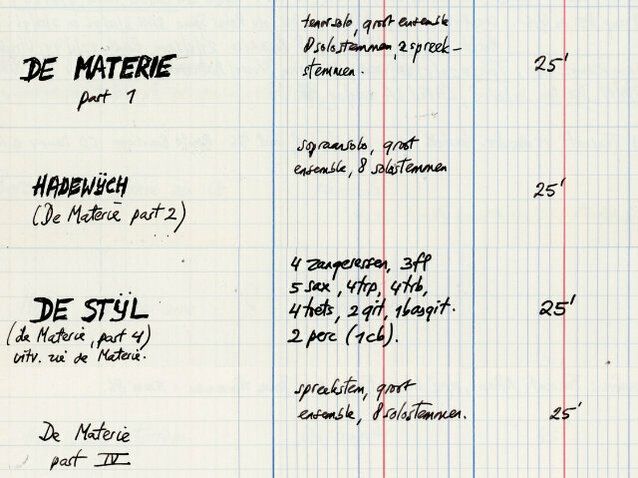
First Movement
The first movement of De Materie (De Materie Part I) draws its inspiration from the history of the Netherlands in the 16th and 17th centuries. Louis Andriessen sets to music the Act of The Hague of 1581, which formalized the independence or emancipation of several Dutch provinces from the King of Spain, thereby establishing the Netherlands as one of the first modern republics. He continues with a 17th-century shipbuilding treatise by Nicolaas Witsen, sung by a choir; the composer was fascinated by the idea that a single material (such as wood, in this instance) could be transformed into vastly different objects (a musical instrument or a ship) through the power of the human mind, subsequently inspiring new ideas or emotions. The text meticulously lists the various components of a ship as well as the tools required for its construction. He then moves on to the Idea Physicæ by the philosopher David van Goorle (known as Gorlaeus), who, during that same era, was already laying the groundwork for the concept of atoms and indivisible particles (from the Ancient Greek átomos, literally “indivisible”) in an effort to penetrate the very heart of matter.
Musically, this first movement opens with 144 orchestral hammer blows – resounding strikes that follow one another at an increasingly frenetic pace, symbolizing revolt, destruction, and reconstruction. The hammering intended to bring down an oppressive system thus transforms into the industrious hammering of a shipyard. The choir singing Nicolaas Witsen’s treatise is answered by a tenor embodying the philosopher Gorlaeus.
Second Movement
In the second movement (Hadewijch), Louis Andriessen draws inspiration from the Seventh Vision of Hadewijch of Antwerp. In this text, the 13th-century mystic and poet recounts her encounter with God – an experience she feels “physically” with such intensity that she likens it to the fervour of romantic love. Her union with Christ unfolds as she moves step by step through a church, torn between the spiritual elevation of the experience and the materiality of the world around her, which anchors her to her physical body.
In this second movement of De Materie, the composer links the mystical ascent of the Seventh Vision to the union of two lovers. In what are arguably the finest pages of his repertoire, Andriessen unfolds music that is celestial – at once spellbinding and mysterious, ethereal and strikingly beautiful – creating a sharp contrast with the resounding, obsessive nature of the first movement.
Third Movement
Structured like the preceding sections around a specific era and emblematic texts, the work’s third movement, De Stijl, explores the 20th century. It juxtaposes the Principles of Plastic Mathematics by the philosopher-priest M. H. J. Schoenmaekers with the work of painter Piet Mondrian – specifically his canvases composed of black lines and geometric colour arrangements.
Set to music drawing on disco and boogie-woogie (styles that also morph into a fugue), Louis Andriessen creates a dialogue between mathematical abstraction and geometric abstract painting. This interaction is embodied by a dancer who recites memories of Mondrian in a rhythmic cadence (revealing, among other things, that the painter was a dancer himself).
Fourth Movement
To conclude De Materie, Louis Andriessen turns to the figure of scientist Marie Curie in an introspective finale. The fourth movement opens with excerpts from the work of Dutch poet Willem Kloos, recited by the choir. It proceeds primarily by setting to music the speech Marie Curie delivered in 1911 upon receiving her second Nobel Prize (this time in Chemistry). In it, she speaks of radioactivity, that invisible force emanating from matter, alongside the profound grief of losing her husband and colleague, Pierre Curie (all while facing a media scandal and virulent xenophobic attacks due to her romantic relationship with physicist Paul Langevin).
In this way, Louis Andriessen brings De Materie full circle, evoking both matter and immateriality, as well as the spirituality of the emotions that arise from them.
Comments