


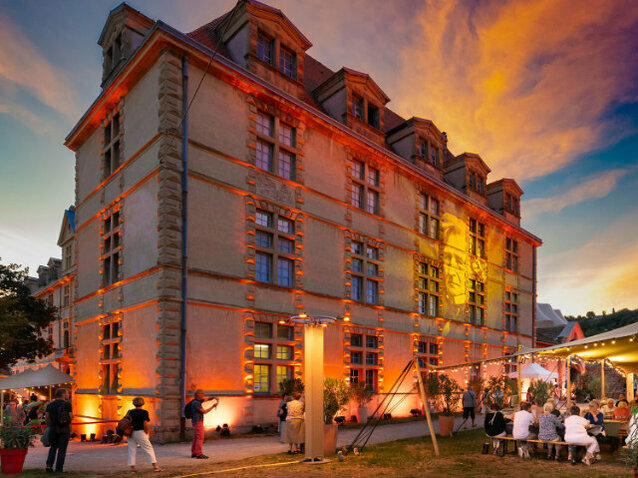
 © Festival Berlioz
General Information
- Opera house name :Festival Berlioz (Côte-Saint-André)
- City, country :La Côte-Saint-André France
- Localization :La Côte-Saint-André Open map
- Official website URL :https://www.festivalberlioz.com/
Description
Every summer, the Berlioz Festival brings a vibrant and spectacular musical legacy to life in La Côte-Saint-André – the birthplace of Hector Berlioz, located not far from Lyon, France. Born of a deep commitment to the Romantic composer’s body of work, the festival has gradually established itself as a major international classical music event, driven by the momentum of grand symphonic masterpieces and a desire to create a dialogue between Berlioz’s heritage and the present day.
Its history is one of gradual evolution. As early as the 1840s, Berlioz himself used the word “festival” to describe musical events that gathered crowds around a shared location and a shared passion. Later, tributes were paid to the composer – notably in Paris, and subsequently in Grenoble and La Côte-Saint-André during the centenary of his birth in 1903. An initial Berlioz Festival was launched in Lyon in 1979 under the initiative of Serge Baudo, before a new chapter began in 1994 in the musician's hometown. Since then, the festival has evolved under successive artistic directors, culminating in the international expansion driven by Bruno Messina from 2009 onwards.
Today, the festival takes place in venues that beautifully complement its heritage-focused and poetic mission. In La Côte-Saint-André – the event's beating heart – concerts are held in the Cour du Château Louis XI, a vast stone setting where grand symphonic works can be heard in all their majesty; the medieval market hall (Halle médiévale), a more intimate and vibrant space; and the Hector Berlioz Museum – the composer's birthplace – where the gardens host select free events. Then there are venues like the Church of Saint-André (host to the Festival’s chamber music concerts) and the Taverne (inviting festival-goers to “extend the evening with friends over a drink and a plate of local produce, accompanied by traditional and popular music”), both of which remind us how music can truly inhabit spaces rich in character.
Further afield, the festival extends to other heritage sites across the Isère region: Saint-Antoine-l’Abbaye – with its abbey church and the Chapel of Saint-Jean-le-Fromental – Marnans and its priory, and Beauvoir-en-Royans with the Carmelite convent. Nor should we overlook the area’s various media libraries, which open the festival up to new audiences and different kinds of encounters. Thus, the Berlioz Festival is more than just a concert series; it is a journey through places steeped in history – a flow connecting stone, voices, and the imagination – where the spirit of Berlioz continues to inspire, unite, and uplift.
Comments