


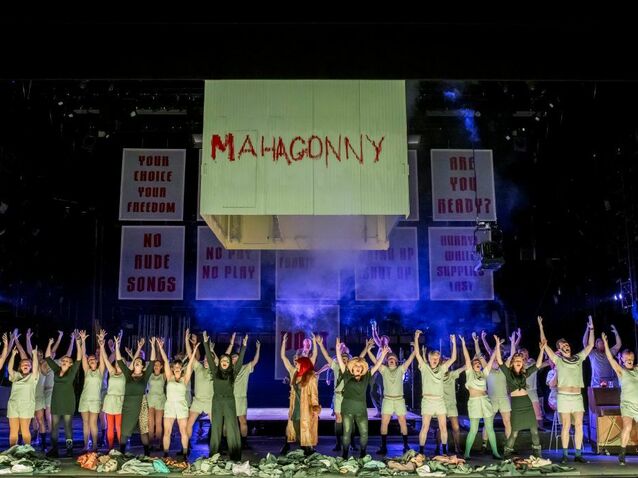
 © Tristram Kenton
Kurt Weill’s Rise and Fall of the City of Mahagonny, with a libretto by Bertolt Brecht and Elisabeth Hauptmann, describes the establishing and subsequent implosion of a city that is designed to give people fun because, it is asserted, there is nothing else in the world on which to rely. Situated somewhere in America, it is initially founded by three fugitives (Leokadja Begbick, Fatty the Bookkeeper and Trinity Moses) who find themselves unable to flee any further from the pursuing federal agents. They then attract people disillusioned with their own lives, including four Alaskan lumberjacks led by Jimmy MacIntyre.
For a period, life is tranquil in Mahagonny, but this irritates both the fugitives, because people are leaving through boredom which is hitting their profits, and the restless Jimmy. He declares that everything should be permitted, and when an impending hurricane not only misses Mahagonny, but also hits the federal agents who were chasing the outlaws, everyone is converted to his philosophy. However, the pleasures that Jimmy advocates (eating, love making, fighting and drinking) actually come into conflict with a lust for money, and he is finally tried and executed by the city not for his many hedonistic crimes, but for failing to pay his bar bill!
The opera was first performed on 9 March 1930 at the Neues Theater in Leipzig, before being banned by the Nazis in 1933 and not enjoying a significant production again until the 1960s. There is still debate over whether it is predominantly a critique of American society or of the Weimar Republic, as Berlin in the 1920s was particularly associated with rampant prostitution, political corruption and economic crises. Either way, although Weill and Brecht were satirising capitalism as they saw it a century ago, their commentary feels highly relevant today, and director Jamie Manton maximises on the synergies between then and now in his new production for English National Opera.
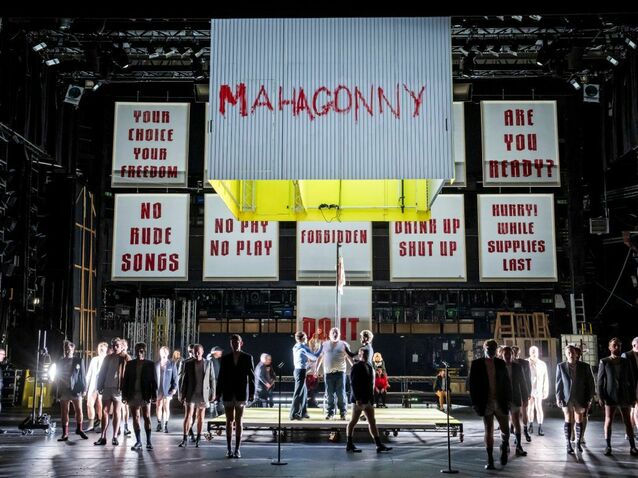
Rise and Fall of the City of Mahagonny 2026 © Tristram Kenton
Manton sets the action broadly in the modern day, with some Mahagonny inhabitants carrying mobile phones. In addition, some of the women’s stylised haircuts and brightly coloured clothes give a nod to the works of Expressionist painter Ernst Ludwig Kirchner, and hence to the original time period. There is more than a touch of the Brechtian about the staging, which feels appropriate given the opera’s librettist, as the fugitives’ truck (which here becomes an all-purpose prop) is wheeled around and raised high by actors or stage hands in full view of the audience.
Milla Clarke’s designs leave an entirely open space where rigging in the wings, and tiered seating at the back of the stage, are completely visible. When the hurricane first looks set to strike Mahagonny the fear and pandemonium this unleashes is revealed by Jimmy swinging a spotlight, courtesy of lighting designer D. M. Wood, that has descended to take centre stage.
While a production must do justice to the opera’s array of textures, it also needs to keep the underlying pace and intensity up, and initially Manton’s staging does not do this. Introducing groups of characters by having them walk on treadmills feels like an attempt to inject some movement, but it makes everything seem too stylised and polite. Things are not helped by the fact that the Coliseum stage is a large space to fill at the best of times, with the act of leaving it open diffusing the requisite energy even further. There are certainly occasions when some chorus members sing from the tiered seating at the back of the stage, which only contributes to the feeling of being underwhelmed.
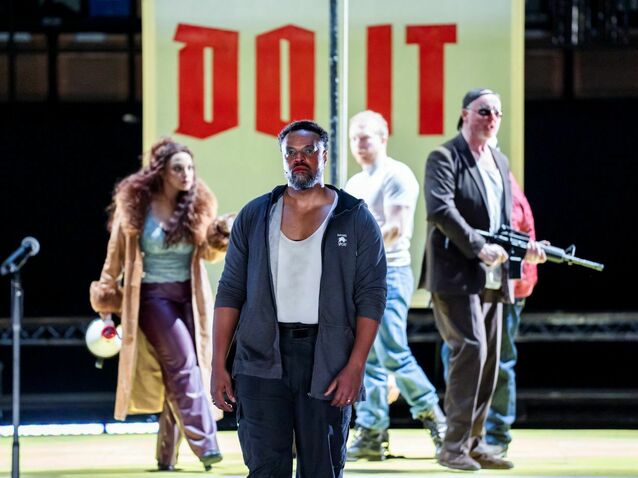
Danielle de Niese, Kenneth Kellogg, Alex Otterburn, Mark Le Brocq, ENO’s Rise and Fall of the City of Mahagonny 2026 © Tristram Kenton
From the very start, however, the strength of the cast shines through, with the trio of fugitives and quartet of Alaskans all working well together. Rosie Aldridge is quite a formidable Begbick and Mark Le Brocq an astutely observed Fatty, while, as Trinity Moses, Kenneth Kellogg’s presence proves to be just as powerful as his bass. Simon O’Neill, often seen in Wagnerian heldentenor roles, is luxury casting as Jimmy, and throws himself completely into the part as his voice more than conquers every demand placed on it. As his fellow Alaskans, Elgan Llŷr Thomas and David Shipley effectively carry off the respective death scenes of Jack O’Brien and Alaska Wolf Joe, while Alex Otterburn provides a splendid portrayal of Bank-Account Billy, the so-called friend who refuses to save Jimmy’s life by paying his debt.
It is towards the end of Act I, when the hurricane threatens, that the staging really finds its feet, and from then on it hits the mark many more times than it misses it. The chorus sounds extremely good, and whether its members are huddled in the truck, spread right around the stage or are confronting us en masse at its front, they help to make the experience feel overwhelming. Danielle de Niese, who plays the prostitute Jenny Smith, is highly engaging throughout the evening and reveals enormous versatility. The sweeter sound that she reveals in ‘Moon of Alabama’ contrasts markedly with her later cries of ‘No, they said, the men of Mahagonny’, when the anguish in her voice only emphasises the unrelenting nature of the horror we see before our eyes.
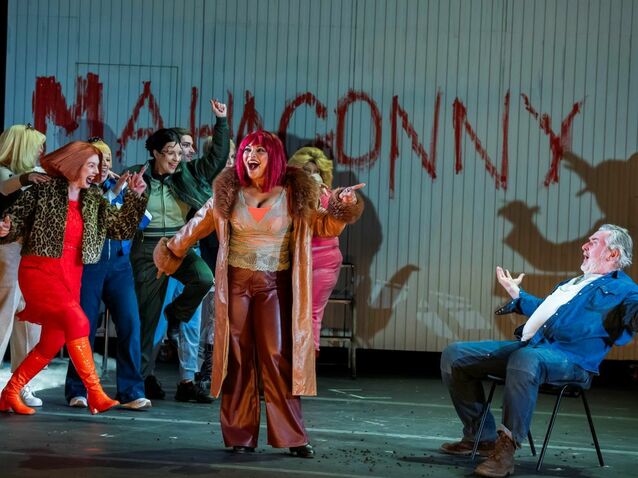
Danielle de Niese, Simon O'Neill and the Cast of ENO’s Rise and Fall of the City of Mahagonny 2026 © Tristram Kenton
There are some excellent touches throughout as we see how Begbick waters down the whisky to maximise profit by hooking up a hose in the bar to a toilet at the back of the stage. There is also a slightly Surreal element as the short introduction to each scene is delivered by people wearing hoods that see their entire heads become megaphones. One person dances, accompanied by a pianist (Murray Hipkin) with ‘APPLAUSE’ written on his jacket. The hurricane is similarly represented by a dancer who sports an arrow and exclamation mark, with the map that he consults explaining how it could be diverted around Mahagonny! The production also introduces a little more gender equality for while originally in the love making scene it is the men who queue up to be satisfied by the women, here both sexes form a line.
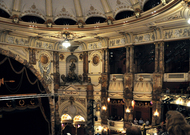
Jeremy Sams’ English translation is excellent, while André de Ridder’s focused and multifaceted conducting contributes substantially to the success of the evening. The degree to which the production is involving is also illustrated by having the by now dead Jack and Joe occupy a box in the auditorium for much of Act III. By providing a link between subject and spectator Jack can address the audience directly, and make us realise that we are complicit in Jimmy’s execution because surely we had the opportunity to bail him out, yet we all sat silently in our seats and did nothing.
By Sam Smith
Rise and Fall of the City of Mahagonny | 16 - 20 February 2026 | London Coliseum
the 18 of February, 2026 | Print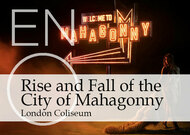






Comments